Tracking a new era of climate solutions: Cleantech growth across the U.S.
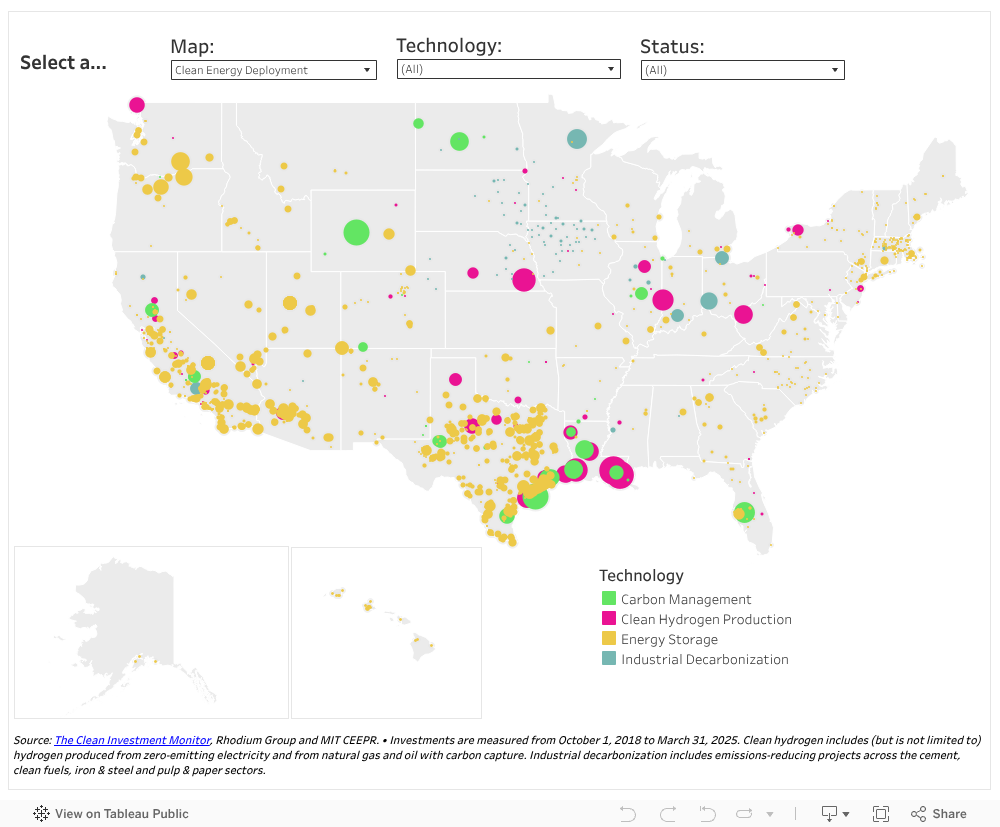
The United States is at the dawn of a technology boom to tackle climate change, fueled by historic laws, increased money from both public and private funders and a heightened sense of urgency as we face more extreme weather exacerbated by a warming world.
Cipher’s Cleantech Tracker shows the progress of select emerging technologies: carbon management, clean hydrogen production, hydrogen electrolyzer manufacturing, critical minerals processing, energy storage, sustainable aviation fuel, solar component manufacturing, wind component manufacturing and industrial decarbonization projects.
These tech types are critical parts of a broader puzzle of technologies, ranging from wind and solar farms to carbon dioxide pipelines to electric vehicle manufacturing. Cipher is intentionally focused on technologies that receive less attention from the media and investors and on sectors that are harder to clean up compared to others, though our tracker and focus will evolve with time. Learn more about the technologies we’re including in the Tracker here.
The Cleantech Tracker map is a window into the transformative technological landscape, illustrating where innovations are taking root. We provide in-depth reporting on the potential impacts they can have on local economies and in the global fight against climate change.
About the Cleantech Tracker
The Cleantech Tracker includes technologies core to Cipher’s coverage areas: carbon management, clean hydrogen production, hydrogen electrolyzer manufacturing, critical minerals processing, energy storage, sustainable aviation fuel, solar component manufacturing, wind component manufacturing and industrial decarbonization projects. You can read more about each technology in our technology definitions. Cipher updates the data as it becomes available as technologies move through the development pipeline, so be sure to check back to see the latest trends. Over time, we will also layer in other technologies. We largely cull and analyze data from the Clean Investment Monitor, a database by research firm Rhodium Group and Massachusetts Institute of Technology’s Center for Energy and Environmental Policy Research. Click here for our comprehensive methodology.Technology Definitions
- Carbon management: This includes point-source carbon capture and direct-air capture technologies. This does not include transportation or sequestration of carbon. The data shows a wide variety of applications for carbon capture, ranging from liquefied natural gas (LNG), coal and natural gas electricity generation.
- Electrolyzer manufacturing: This refers to the manufacture of electrolyzers, which are zany-sounding machines used to produce hydrogen using electricity and water. The manufacturing methods we are currently tracking include (get out your chemistry books) alkaline and proton exchange membrane (PEM) electrolyzers and solid oxide electrolyzer cells (SOEC).
- Clean hydrogen production: This includes the actual production of hydrogen fuel with the above electrolyzers (PEM, SOEC) and several other methods: methane pyrolysis (the thermal breakdown of methane into hydrogen and solid carbon), natural gas with carbon capture and more.
- Sustainable aviation fuel: SAF embodies a range of liquid fuels produced from various raw materials through different technologies. The fuel is capable of directly replacing or mixing with traditional fossil fuel-based jet fuel. One key approach is the Fischer-Tropsch technology, a process that can transform a wide range of biomass and waste feedstocks, including carbon dioxide, into SAF.
- Critical mineral processing: This mostly includes projects that refine critical minerals — such as cobalt, lithium, graphite and rare earth elements — as well as some projects that recycle critical minerals. This does not include projects that only extract, or mine, critical minerals.
- Energy storage: Energy storage includes grid-scale storage deployment. This is mostly lithium-ion batteries, though there are also a handful of pumped hydroelectric storage projects, as well as other kinds of battery tech and materials (i.e., long duration energy storage) that are under development.
- Solar manufacturing: This includes the manufacture of the many components needed to assemble a solar panel, including solar cells and the “building blocks" of solar cells (wafers, silicon ingots and polysilicon); inverters, which convert the electricity produced by solar panels into useable electricity for the grid; power optimizers and trackers, which both aim to optimize power generation and collection; torque tubes, which connect panels and allow them to rotate and follow the sun; backsheets, which are the back of the solar panel; mounting equipment; and fully assembled modules (aka a single solar panel).
- Wind manufacturing: This includes the manufacture of wind turbine components, including blades, foundations, towers, turbines and nacelles — the structures at the top of wind turbines containing the machinery to turn wind power into electricity.
- Industrial decarbonization refers to a range of technologies that are reducing emissions at industrial facilities, specifically in the cement, clean fuels, iron & steel and pulp & paper sectors. This category tracks investments into carbon capture and storage technologies across all four of these sectors, as well as other, industry-specific decarbonization pathways, such as alternative, low-carbon cement and direct reduced iron.