With Trump’s support, nuclear energy eyes a revival
Latest News
“America’s nuclear energy renaissance starts now.”
So said Chris Wright, secretary of the United States Energy Department, in late March. He was announcing his agency had relaunched a Biden-era program to award $900 million in support of new small modular reactors.
Earlier that month, the Energy Department also announced it was disbursing an almost $57 million loan to restart a nuclear power plant in Michigan.
Amid its high-profile embrace of fossil fuels, the Trump administration is also backing nuclear energy, a carbon-free and steady source of power with enduring bipartisan support. The commitment is coming at a key time for the sector, which has been hamstrung by high costs, atrophied supply chains and dwindling workforces.
In calling for a nuclear renaissance, Wright, a fracking executive who was also a member of the board of nuclear innovation company Oklo until he joined President Donald Trump’s cabinet, echoed a long-standing, yet-to-be-realized goal of the industry.
For decades, the nuclear sector struggled to rebut public concerns over safety following high-profile accidents. But the tide of public opinion is shifting as understanding of the technology has grown. Indeed, nuclear is one of the safest ways to produce electricity.
Still, the share of the nation’s electricity that comes from nuclear energy has remained relatively flat, at about 18%, according to the U.S. Energy Information Administration.
Now, though, surging electricity demand, Trump’s focus on “energy dominance” and backing from a slew of deep-pocketed tech companies like Google and Amazon are all giving the industry momentum it hasn’t seen in decades. Existing plants are being extended or restarted and new nuclear-reactor technologies are on the way.
“We can do this. We just have to put our minds to it and make it a priority,” said Daniel Poneman, co-chair of the Nuclear Energy and National Security Coalition. He is also the former CEO of Centrus Energy, a nuclear fuel company and a former deputy secretary in the Energy Department.
Government support
Besides cash infusions, the nuclear industry also needs reliable tax credits for investment and production, like those included in the 2022 Inflation Reduction Act (IRA), in order to be cost competitive.
“Just to get us to the point where we are on par with other generation sources,” said Juliann Edwards, chief development officer of The Nuclear Company, a nuclear deployment company.
Republicans in Congress are currently weighing the rollback of many clean energy provisions in the IRA. If those credits are eliminated, the nuclear industry would need a new tax credit to help ramp up development and construction, Edwards said.
Costs are coming down incrementally. The fourth reactor at the Vogtle nuclear plant in Georgia, completed in 2024, cost 20% less to build than the plant’s third reactor, which came online a year earlier. But electricity from nuclear plants is still more expensive than other baseload (always on) sources of power, like natural gas power plants, according to data from Lazard, a financial advisory firm.
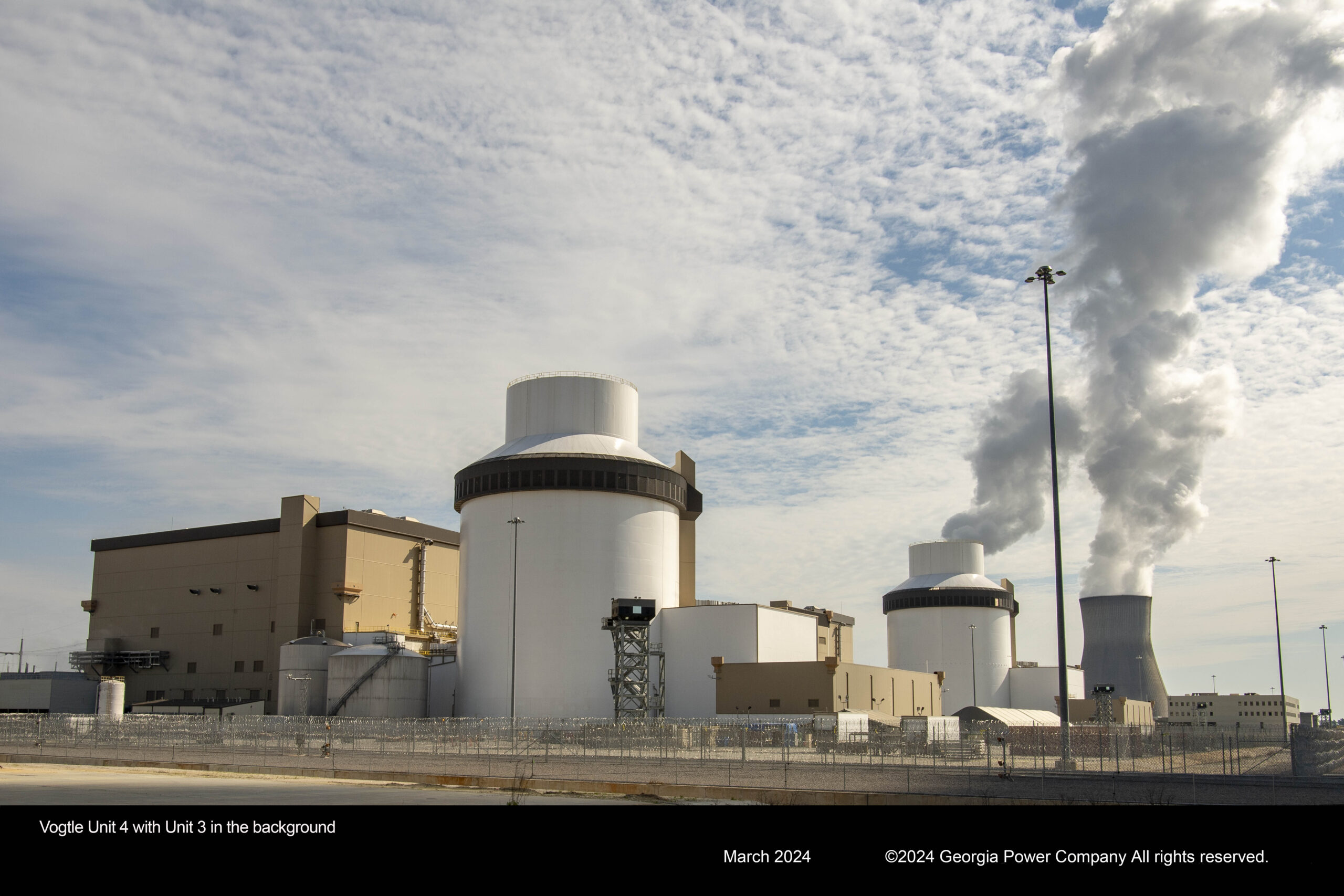
Vogtle Unit 4 in the front with Unit 3 behind it, located in Waynesboro, Georgia. Photo credit: Georgia Power Company.
The industry will have to improve performance irrespective of government support, said Brett Rampal, the senior director of nuclear power and strategy at energy research and investment firm Veriten.
“This industry has a history of poor cost-estimating and over-promising overall,” Rampal said.
In response to a request for comment, an Energy Department spokesperson said: “Under President Trump’s leadership and alongside the entire National Energy Dominance Committee (NEDC), Secretary Wright and the Energy Department is hard at work to ensure the American nuclear renaissance is just around the corner! Rest assured, we are just getting started.”
Supply chains and workforce
Almost all of the existing nuclear capacity in the U.S. comes from reactors built in the 1970s and 1980s.
Rising construction costs, negative public opinion following the 1979 accident at the Three Mile Island nuclear plant in Pennsylvania and, later, competition from ultra-cheap natural gas resulted in far fewer reactors built in the last 30 years. As a result, supply chains have atrophied and the country’s highly-skilled nuclear workforce has dwindled.
Wright’s renaissance will require reestablishing those supply chains to fuel, build and staff the reactors.
“All of this has to be well choreographed and planned,” said Jacopo Buongiorno, a nuclear science and engineering professor at Massachusetts Institute of Technology.
For example, a company making component parts for a reactor will not ramp up production until it sees enough orders on the books to justify doing so.
Tariffs imposed by the Trump administration could be “most likely bad news” for new nuclear plants because, like all large construction projects, they require a lot of concrete and steel imported from other countries, Buongioro said.
But one silver lining of the tariffs might be pressuring the industry to reshore domestic nuclear supply chains, most of which are currently overseas.
The U.S. imports virtually all of its uranium, for example, and depends largely on Russia and China to enrich that uranium before it becomes fuel.
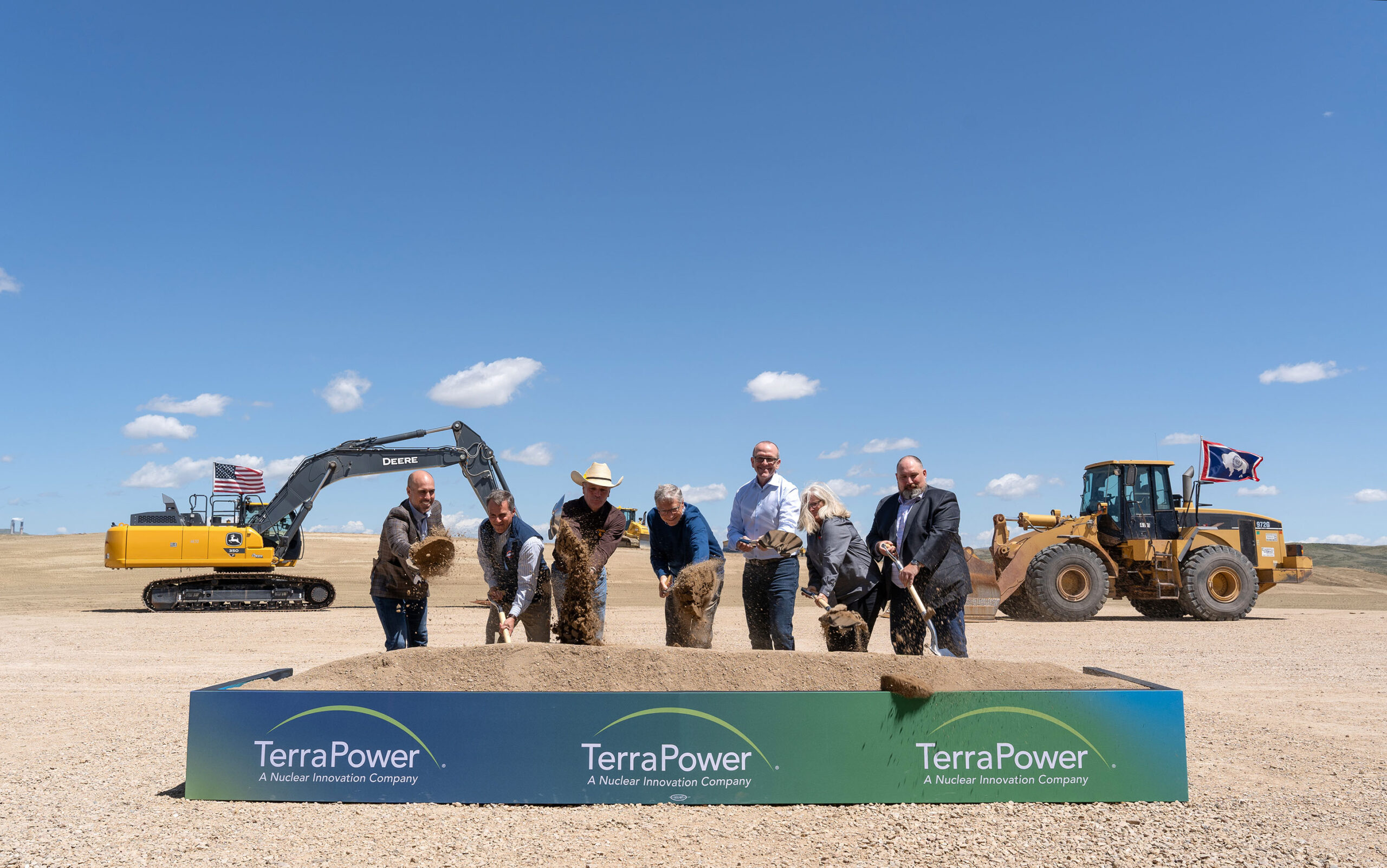
The groundbreaking ceremony for non-nuclear components of the TerraPower reactor in Kemmerer, Wyoming, in June, 2024. From Left to Right: Brian Smith, deputy assistant secretary for nuclear reactors, U.S. Energy Department; Craig Albert, president and chief operating officer, Bechtel Group; Mark Gordon, governor of Wyoming; Bill Gates, founder and chairman of TerraPower; Chris Levesque, CEO of TerraPower; Cindy Crane, CEO of Pacificorp; Dick Garlish, president of Rocky Mountain Power. Photo credit: TerraPower.
Selling a next-generation reactor without a long-term source for the fuel will require investing in reactors and fuel concurrently, said Dan Leistikow, vice president of corporate communications at Centrus, a nuclear fuel supply firm that, in 2023, produced the first supplies of the fuel used in advanced reactors in the U.S. in more than 70 years.
Last week, the Energy Department announced it was committing to meeting the “near-term” fuel needs of five advanced reactor companies from small government stockpiles. It’s a notable first step, but not enough for commercial-scale supply chains.
Congress appropriated $3.4 billion toward developing nuclear-fuel supply chains as part of the IRA and the bipartisan government funding bill in March 2024. Centrus is vying for this funding, which it thinks would ideally go to American companies. An Energy Department spokesperson didn’t respond directly to a question about whether this part of the IRA could be at risk.
Long timelines
While advanced reactor companies like TerraPower and X-energy have received government and tech-industry support, and in some cases have already broken ground, their reactors will not be turned on until the early 2030s at best.
The sector is now facing “what were perhaps very, very ambitious” claims around the timing and costs of standing up new nuclear projects, said Rampal.
Nuclear plants must work through safety measures with the Nuclear Regulatory Commission, which can take years, plus secure permits, develop supply chains and build the reactors.
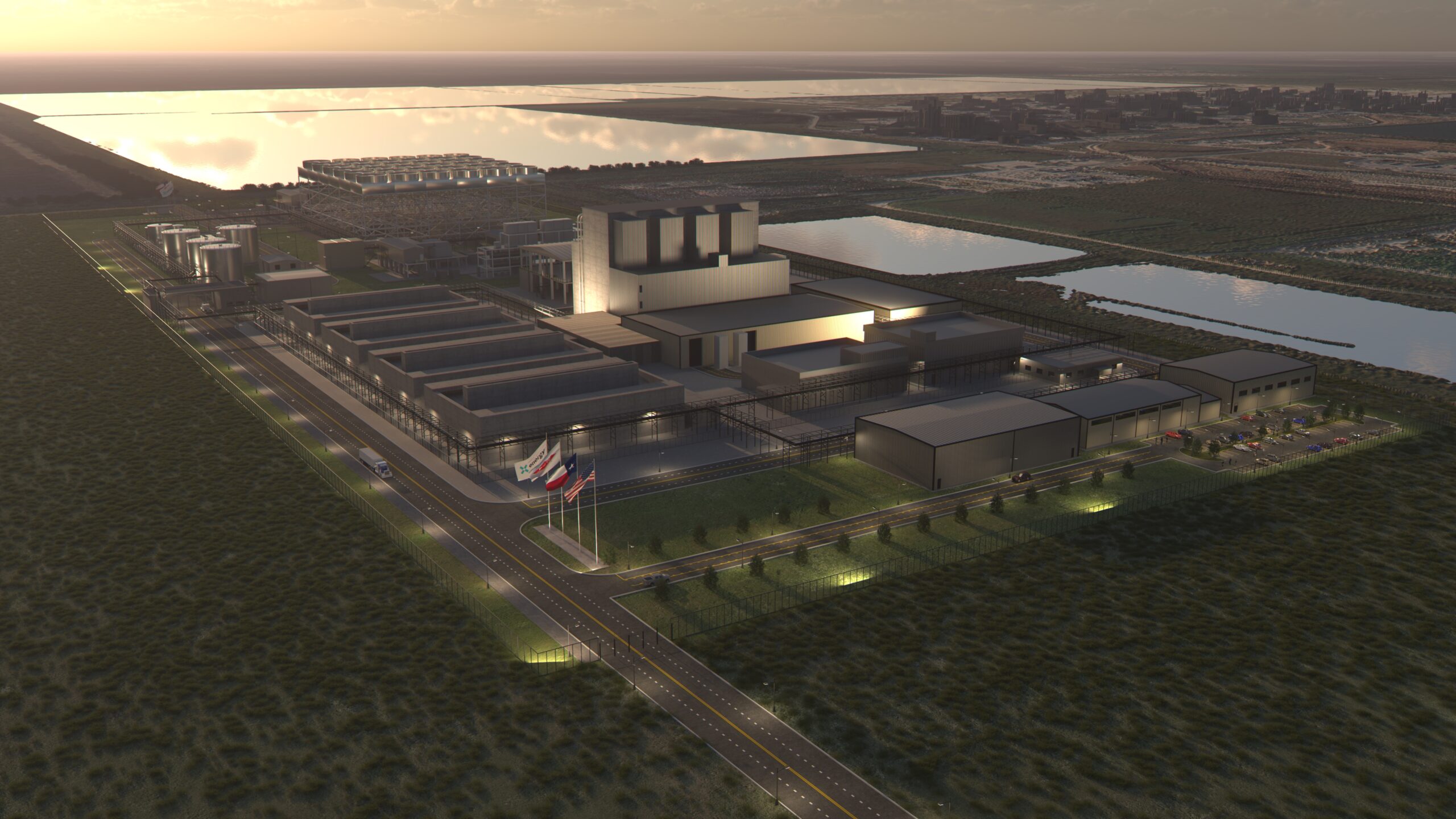
An artist rendering of the project in Seadrift, Texas, where X-Energy plans to install four nuclear reactors. Photo credit: X-Energy.
A bipartisan law passed in 2024 required the NRC to speed up its regulatory processes, and the agency “has worked hard” to make changes, said Scott Burnell, spokesperson for the NRC, including steps like replacing in-person meetings with electronic filings. There have been signs of success: It took less than 18 months for the NRC to issue Kairos Power construction permits for a test reactor facility in Tennessee, and a safety report for TerraPower’s construction permit in Wyoming landed a month ahead of schedule.
An Energy Department spokesperson pointed to an initiative the agency kicked off under Wright to make it possible to “fast-track permitting” for energy infrastructure, including nuclear projects, on Energy Department land.
Nevertheless, building a nuclear reactor is inherently a significant undertaking.
“It’s a longer-term infrastructure investment,” said Edwards of The Nuclear Company. “But once it’s there, it’s there for 60/80 years … you’re spending a little bit more time up front, but then you sustain your future.”
Editor’s note: TerraPower was founded by Bill Gates, who is also the founder of Breakthrough Energy, which supports Cipher.