What Trump’s win means for China’s cleantech industry
Latest News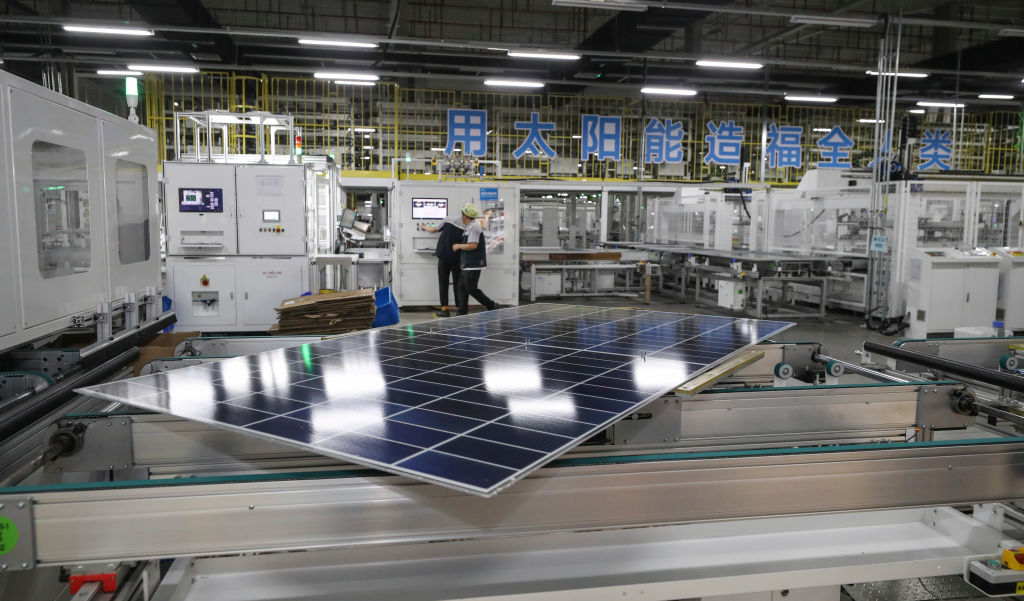
Few countries will feel the impact of Donald Trump’s victory in the United States presidential elections more than China, the world’s leader in cleantech and a major U.S. trading partner.
Since the Biden Administration introduced the Inflation Reduction Act (IRA) in 2022 to foster domestic cleantech manufacturing, a wave of Chinese companies — ranging from solar manufacturers to carmakers — have planned or already built factories in North America to bypass tariffs and reap tax credits while also tapping into the profitable U.S. market.
Their planning now faces great uncertainty with the return of the former president, who launched an intense trade war with China during his first term and is deeply antagonistic against the Asian powerhouse.
China’s “new three” — a nickname for solar cells, electric vehicles (EVs) and lithium batteries — “will be on the front line” to take any hit from the looming policy shift under Trump, Song Xin, founder of Sinnvoll Global Strategy, a think tank with offices in Beijing and Berlin, told Cipher.
The new three are the current focus of China’s economy, said Song, and Trump has promised to “rescind all unspent funds under the misnamed Inflation Reduction Act” on his first day in office. Although it remains uncertain how much Trump can repeal as president, with Republicans in control of both chambers of Congress, much of the IRA is under scrutiny.
Potential opportunities exist for China too in America’s new political landscape. “The green trade between China and other developing countries may go up” if the U.S. withdraws from the competition, according to Kevin Mo, principal of the Institute for Global Decarbonization Progress (iGDP), a Beijing-based think tank.
Chinese firms’ American dream dims
Chinese solar manufacturers are already feeling Trump’s shadow. On the day after the election, news came that a major Chinese solar firm, Trina Solar, was selling its brand-new factory in Wilmer, Texas. The plant began operations on November 1 and Trina Solar announced the sale the following week to Freyr, a Norwegian battery company.
Trina announced the one-million-plus-square-foot facility in September last year, with a view “to create an ecosystem of American manufacturing that can serve the burgeoning U.S. solar market,” Steven Zhu, president of Trina Solar U.S., said at the time.
The solar giant, based in Changzhou in eastern China, told Politico that Trump’s win had “nothing to do” with the sale; the decision was based on the company’s long-term growth in the U.S. Trina Solar didn’t provide a comment to Cipher in time for publication.
Still, the deal may forecast what is to come under the incoming administration, according to Yana Hryshko, head of global solar supply chain research at consultancy Wood Mackenzie. She believed it is “a sign” Chinese solar companies will likely withdraw their investments from the U.S. solar manufacturing industry.
“There are a lot of Chinese interest in the U.S. solar manufacturing industry and the unpredictability of the market has increased a lot since Trump being elected,” Hryshko told Cipher.
The future of tax credits
After playing cat-and-mouse with Washington over tariffs for more than a decade, many Chinese solar executives finally decided to open factories on American soil over the past two years, largely driven by incentives in the IRA.
In that short time, Chinese companies have come to control much of the market. By the end of this year, the U.S. is expected to have 45.7 gigawatts (GW) of solar manufacturing capacity either operating or under construction. Of that, 21.3 GW — 46.6% — belong to Chinese companies or companies with Chinese roots, according to Hryshko.
Now, these manufacturers are worried the shift in politics could mean they may not actually receive the tax benefits they otherwise would have for building these factories under the IRA, said Hryshko.
In addition to Trump’s plan to roll back IRA funds, Florida Senator Marco Rubio, Trump’s pick for Secretary of State, has introduced a bill aimed at prohibiting companies “associated with governments of foreign adversaries,” which include China, from receiving manufacturing tax credits.
Roadblocks for Chinese EVs
The prospect for Chinese EV and battery manufacturers is unclear. The Biden administration has effectively shut Chinese carmakers out of the U.S. market through a series of measures, including a 100% tariff on Chinese EV imports and a ban on EVs made with Chinese batteries receiving tax credits.
Trump, meanwhile, has invited Chinese carmakers to open factories in the U.S. as long as they use American workers, while also threatening to put a 200% tariff on cars made by Chinese firms in Mexico. It is unclear what policy Trump will ultimately introduce.
Right now, no Chinese carmakers have invested in U.S. manufacturing. Chinese battery suppliers have made some moves; CATL entered a technological partnership with Ford and Gotion has announced plans to build factories in Michigan and Illinois.
But local and municipal pushback has forced these projects to be dialled back, “showing that investing in local manufacturing in the U.S. will remain a thorny issue and risky move,” said Xing Lei, a U.S.-based independent analyst of the Chinese auto industry.
Challenges for collaborations
Academic and technological collaborations between the two countries also face an uncertain future.
While China boasts unparalleled cleantech manufacturing capacity, American institutions are known for research and developing innovation technologies.
For years, Chinese cleantech companies have been acquiring the intellectual property of U.S. technologies through license agreements or co-invention, on top of their own research efforts, according to Geoffrey Chun-fung Chen, an associate professor of China Studies at Xi’an Jiaotong-Liverpool University in Suzhou, China.
“It remains to be seen whether those kinds of collaborations will be allowed to continue,” Chen told Cipher.
Research collaborations on the academic level may also meet “huge challenges,” he added, pointing to a highly controversial campaign launched by the first Trump administration that hunted for so-called Chinese spies at American universities.
Opportunities for China on the horizon
If the U.S. rolls back its investments and support for cleantech and withdraws from the 2015 Paris Climate Agreement — for the second time — it will lose its position as a global climate leader, Mo, principal of Beijing-based think tank iGDP, told Cipher.
China could step in to play a larger role on the world stage.
“China should continue fulfilling its climate pledges and supporting the Global South in reducing emissions and adapting to climate change together with the European Union and other countries and regions,” Mo said. “Chinese ‘new three’ companies will get more opportunities in developing countries.”
Chen agreed. “In a sense, cleantech is a country’s soft power,” he said.
Ultimately, Trump’s anticipated backpedalling on cleantech policies could end up hurting the U.S. as much — or perhaps even more — than it hurts China.
Take solar manufacturing, said Hryshko: In the worst-case scenario, Chinese firms still can export their products to the U.S. from Southeast Asia with increased tariffs. But the U.S. is losing access to the whole solar supply chain, the latest technologies, the best equipment and the best talent in the industry.
“Who is going to teach Americans how to make modules and cells if not Chinese, because no one else can do it,” she said.