Under Trump, carbon capture sector mulls rebrand and sees optimism
Latest News
SAN DIEGO — Cloudy skies are not what one expects in San Diego, but the uncharacteristically cool weather reflected the vibes at a recent carbon capture conference here.
Gathering last month, developers, climate-tech innovators, lawyers and investors were seeking to rebrand as they bid for the new administration’s support of the fledgling carbon management sector.
President Donald Trump’s return to the White House is casting large question marks over the fate of most federal policies, including virtually all climate initiatives. While some have faced high-profile criticism — think electric cars and wind energy — carbon capture technologies have so far not faced similar scrutiny, although uncertainty still looms large.
With explicit support from congressional Republicans and oil companies, leaders in this sector are hopeful the Trump administration will at least leave existing policies already in place.
Baker Botts attorney Ellen Friedman, one of the speakers at the summit, said she was “cautiously optimistic” about carbon capture technology because it enjoys bipartisan support in Congress and in states that voted for Trump, including North Dakota.
“I don’t think this administration is going to turn back the tax credits that have already been established. People have already made investment decisions based on those tax credits and it would be significant if they changed course,” Friedman said.
The focus of the San Diego summit, organized by the advocacy group California Carbon Capture, Utilization, and Storage Forum (CA CCUS Forum) was how to scale the technology for commercial use. But conversations about how to move forward under the new Trump administration overshadowed most discussions, a likely outcome at most conferences underway on most topics (including cleantech) in many parts of the world right now.
Carbon management refers to approaches for removing carbon dioxide from the air or capturing it from industrial sources and power plants, then transporting the gas and either storing it permanently or using it to make new products. These approaches are pricey, technologically complex and time-consuming to get off the ground.
Despite these challenges, carbon capture, utilization and storage (CCUS) and carbon removal technologies are seen by climate scientists as key to keeping greenhouse gas emissions in check. Laws passed during the Biden administration — the 2022 Inflation Reduction Act (IRA) and the 2021 Infrastructure Investment and Jobs Act — included measures to help develop the carbon management industry, leading to the commercial deployment of several projects.
With 19 commercial-scale facilities operating and another 276 facilities in the works, the U.S. remains the world leader in global carbon management, but it risks ceding its leadership if it doesn’t address the gaps in existing policies, the Carbon Capture Coalition reported in its latest blueprint for the technology released in February.
Last year, carbon management projects attracted nearly $1.76 billion in total investments, more than double the amount seen in 2023, according to the latest figures from the Clean Investment Monitor, a database by the Rhodium Group and Massachusetts Institute of Technology’s Center for Energy and Environmental Policy Research.
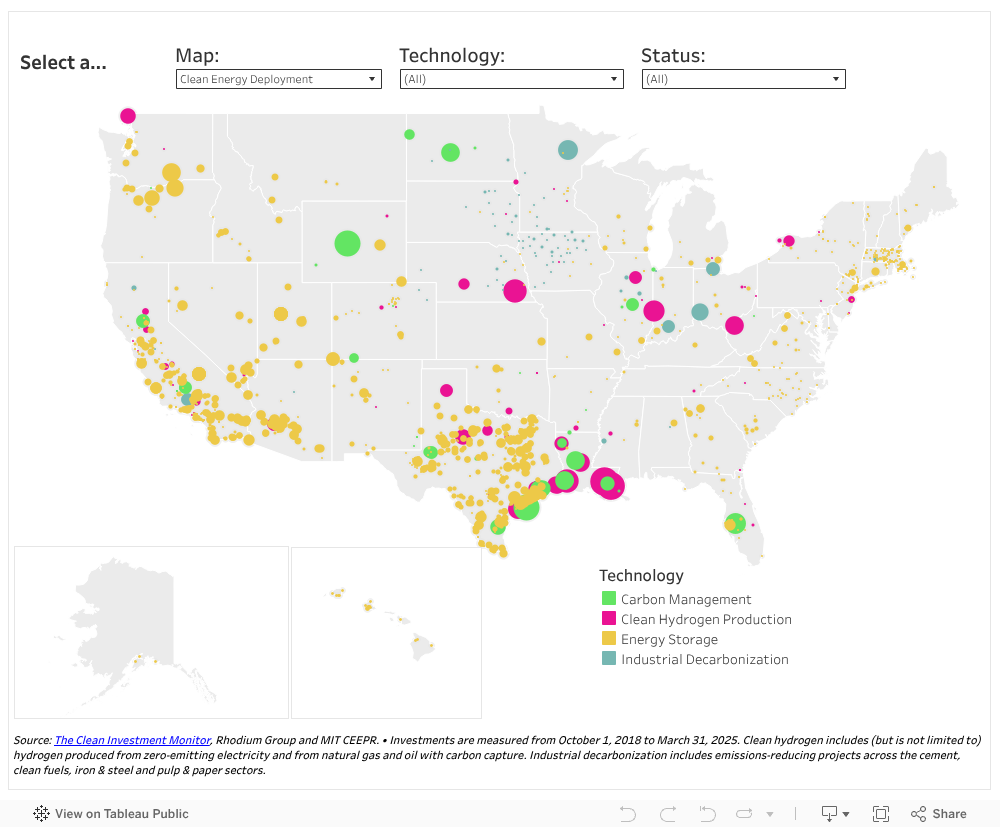
What comes next is unclear. Experts at the San Diego conference welcomed Trump’s nomination of the Governor of North Dakota Doug Burgum, who has supported carbon capture, to head the U.S. Interior Department and the new National Energy Dominance Council.
Attendees also spoke positively about Trump’s executive order to speed up federal permitting processes that would allow more carbon storage sites, although they questioned how the order would be implemented as the administration seeks to slash federal spending. One possibility strongly supported by Burgum is shifting responsibility for permitting carbon storage sites to the states, which the U.S. Environmental Protection Agency under Trump recently allowed West Virginia to do.
A request for comment on the administration’s position on carbon capture wasn’t immediately returned from the White House, or the departments of Energy and Interior.
Conference-goers also voiced concerns about Trump’s freeze of funding under the IRA and infrastructure laws, which paused subsidies for the technology, along with critical CO2 pipeline rulemaking. Other climate technologies are similarly affected.
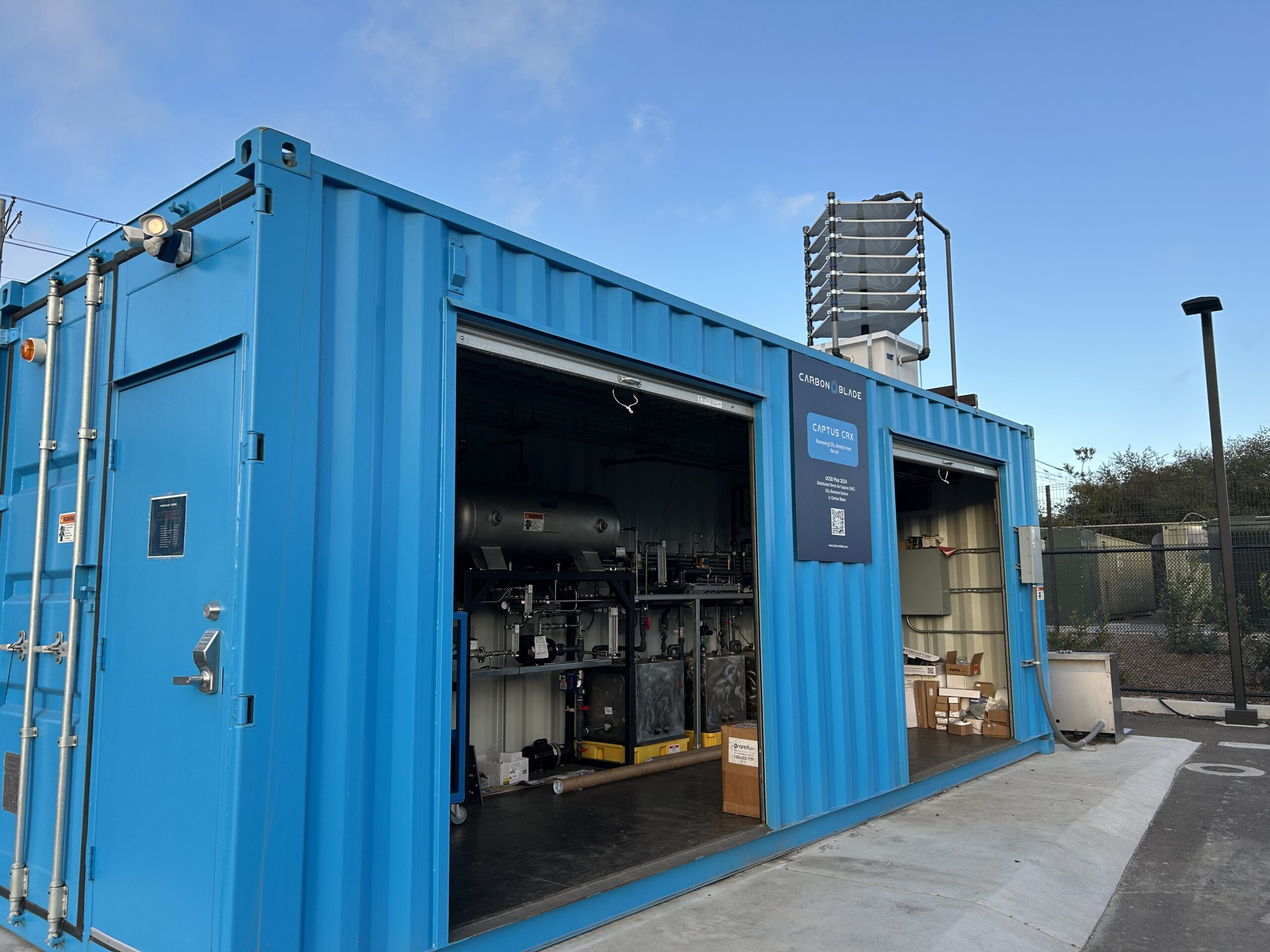
The blue container is San Diego-based Carbon Blade’s modular carbon removal technology on display at the University of California-San Diego’s Clean Energy Center on February 5, 2025. The demo plant operates independently of the grid, using solar panels on its roof to power its process. Photo by Amena H. Saiyid.
“It is certainly any president’s prerogative to review continued spending from a prior administration and it is certainly not surprising that this administration would do so, particularly because [Trump] campaigned on zeroing the Inflation Reduction Act and the bipartisan infrastructure law,” said Vikrum Aiyer, head of climate policy and external affairs at carbon removal firm Heirloom, drawing on his experience working in the Obama White House.
But Aiyer said a prolonged period of funding limbo would risk allowing the U.S. to fall behind China, Europe and other regions investing in climate technologies.
Some of the funding that Aiyer now says is paused includes about half the money allocated to direct air capture hubs, or $1.8 billion. Also in limbo is $1.3 billion for a grant program at the Energy Department called CarbonSAFE, aimed at scaling up commercial carbon capture technology.
Despite all this uncertainty, Aiyer and others believe the U.S. Energy Department will honor the legally binding contracts for carbon management issued under the prior administration, including $600 million earmarked for a joint Heirloom, Battelle and Climeworks carbon removal project in Louisiana.
“The freeze does not take or end that contract from underneath our feet,” said Aiyer, whose company is engaging with lawmakers in Congress to ensure that awarded funds are disbursed in a timely fashion.

Vikram Aiyer, head of carbon removal firm Heirloom’s global policy, airing his concerns about the Trump administration’s pause of federal carbon management funds during a panel discussion on deployment at the Future of CCUS Summit in San Diego on February 7, 2025. Photo by CA CCUS Forum.
In the meantime, developers and investors say the carbon management sector needs to tout itself as a viable business creating products like concrete, rather than as a climate technology reliant on federal handouts, said Lance Scott, chief executive officer of startup Carbon Capture Machine, which captures and converts CO2 into valuable minerals like limestone. “We’ve got to rebrand this industry away from the perception of a costly environmental solution toward the reality that we’re a more cost-effective, job creating, economic engine for American leadership and national security,” Scott added.
Republican members of Congress and at least one fossil fuel company continue to champion carbon management technologies.
Senator John Barrasso (R-Wyoming) reintroduced legislation last month that would give equal tax credits for storing captured carbon dioxide and for using that CO2 to extract fossil fuels as well as make sustainable aviation fuels, concrete or other chemicals. Also last month, Vicki Hollub, CEO of petroleum company Occidental, emphasized in an earnings call that using captured carbon to extract more oil from the ground will be key to future business.
Editor’s note: Heirloom’s investors include Breakthrough Energy Ventures, a program of Breakthrough Energy, which also supports Cipher.