Trump’s former FERC chair: Compromise key to AI energy race
Latest News
NEW YORK — Using solar energy plus battery storage, with natural gas as backup, is the only “plausible path forward” to meet surging energy demand from artificial intelligence data centers in the near-term, said Neil Chatterjee, a former top energy regulator during the first Trump administration.
“If we’re genuinely in an AI race — and we need to win the AI race against the Chinese Communist Party — we need the power right now. ASAP,” said Chatterjee, former chairman of the Federal Energy Regulatory Commission in President Trump’s first term. That means using every possible source of power, he said, which will force both Republicans and Democrats to compromise on their energy agendas.
Cipher spoke with Chatterjee following his appearance at an energy conference organized by BloombergNEF in New York in late April. Chatterjee, a longtime advisor to then-Senate Republican Leader Mitch McConnell of Kentucky, pushed some controversial measures while leading FERC, which is an independent federal agency that regulates the interstate transmission of electricity, natural gas and oil. Today, he is the chief government affairs officer at Palmetto, a clean energy provider.
New power sources traditionally favored by Republicans, like nuclear and natural gas, are in development but unlikely to be operational before 2030 due to long timelines and supply chain delays.
The only solution to meet the near-term power demands of AI data centers, therefore, is combining solar energy plus battery storage with existing natural gas plants nicknamed “peakers” because they kick in during times of exceptionally high demand, said Chatterjee.
That view puts the former regulator in line with a rising chorus of data center developers and some fellow Republicans arguing that renewables will be required to meet enormous energy demands to win the AI race, despite the Trump administration’s embrace of fossil fuels and deprioritization of wind and solar technologies.
In response to a request for comment, the Energy Department pointed Cipher to a speech Wright gave at the Hamm Energy Institute in Oklahoma at the end of April in which he said winning the AI race was a second Manhattan Project, the effort during World War II to develop a nuclear bomb.
“[AI] will have enormous implications on national security and our military, both offensively and defensively,” Wright said. “There is no other option but for the United States to lead in artificial intelligence.”
As to whether and how the U.S. would support renewables to meet that goal, the Energy Department did not immediately respond. But Wright indicated his department would, broadly speaking, “support” solar in a congressional budget hearing last week.
For the U.S. to succeed in the AI era, Chatterjee said three things must happen:
Politicians must compromise
In recent decades, Republicans and Democrats have moved into polarized viewpoints on energy. Republicans, by and large, have supported fossil fuel energy and Democrats, by and large, have advocated for low-emission power sources to mitigate the effects of climate change.
That needs to change, Chatterjee told Cipher.
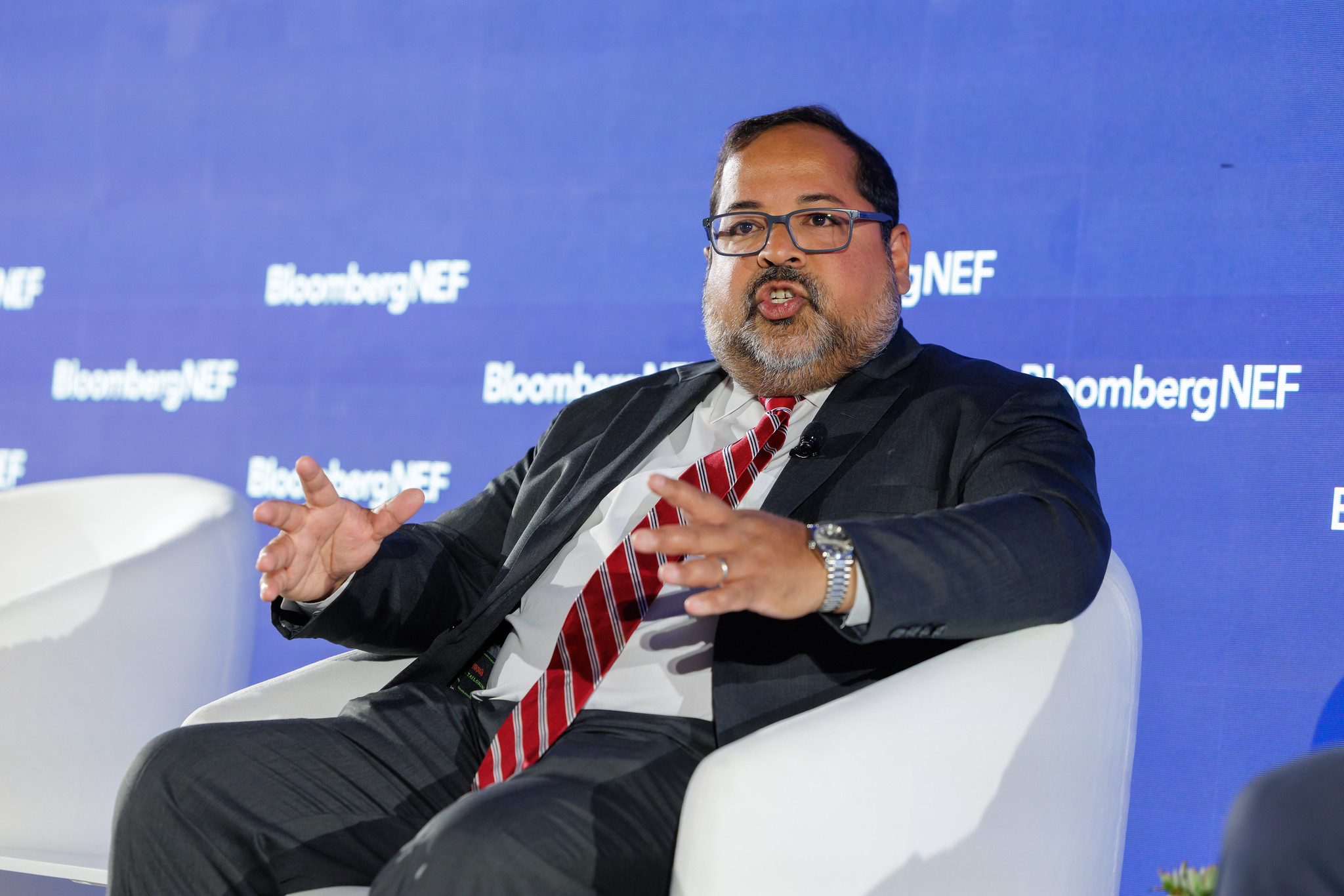
Neil Chatterjee, former chairman of the Federal Energy Regulatory Commission in President Trump’s first term, speaking at the BloombergNEF conference in New York City at the end of April 2025. Photo credit: BloombergNEF.
“On the political left, I think that will mean a recognition that we cannot possibly win the AI race against China while keeping energy reliable and affordable without fossil fuels. There’s no way we can do it. We are going to have to at least have gas for the immediate future,” Chatterjee said.
“For the political right, I think there’s soon going to be an awareness, including with the new administration, that we cannot possibly win the AI race for national security purposes while bringing down the cost of electricity with fossil fuels alone [and] that we’re going to need every available electron, including solar and storage and geothermal and hydrogen and nuclear,” he said.
In addition to being the fastest sources of power generation to build, wind and solar are some of the cheapest forms of energy available today; another stated goal of the Trump administration is driving down energy prices for consumers.
Winning the AI race while keeping energy prices affordable is going to “upend our energy politics,” Chatterjee said.
Also “politically unpopular” for Republicans but necessary given surging energy demand, he said, is getting more out of the existing grid, using virtual power plants, distributed energy resources, energy-efficiency tools and demand response — all of which use computer software to alter energy usage in real time and link up smaller sources of energy generation.
Meeting AI demand is likely to increase emissions in the short term because fossil fuel power plants, including coal-fired ones, will stay online longer than they might have otherwise, Chatterjee said. But in the longer run, he argued, AI will be used to find more and more energy efficiencies.
“Ultimately, emissions will go down because of the benefits of AI,” Chatterjee said.
Permitting must be reformed
Bringing more energy online is going to require more transmission lines and more pipelines to transport natural gas, and that means both Republicans and Democrats will have to work together to pass permitting reform legislation, which has stalled for years on Capitol Hill due to a variety of issues, including partisan divides.
“It is too hard to build things in this country because NIMBY-ism — not in my backyard-ism — is not political, it’s not ideological,” Chatterjee said. “Americans don’t want energy infrastructure in their backyards, whether it’s a pipeline to deliver gas or transmission line to deliver clean energy.”
Legislative permitting reform is likely to require compromise from both parties — such as ceding faster permitting for fossil-fuel infrastructure if you’re a Democrat, and supporting transmission lines for clean energy if you’re a Republican, Chatterjee said: “Everyone’s got to make sacrifices.”
Expecting regulators at FERC to solve the permitting problem without legislative permitting reform in Congress is not realistic, said Chatterjee, who chaired the agency two separate times during Trump’s first administration.
Legislators also need to step up to create rules for new approaches to managing electricity as well.
Because it takes so long to build transmission lines, companies building data centers and power and power plants are looking to co-locate together — a solution FERC is currently wrestling with how to regulate. “If you are a FERC Commissioner, it is a horrible place to be,” Chatterjee said. (More on this challenge in future coverage.)
People need to hear why AI matters
The messaging around artificial intelligence needs to be improved, Chatterjee argued, especially its role in protecting national security. Leaders from both parties need to emphasize that AI is an essential national security tool for use in the military and robotic warfare, he said: “There is bipartisan consensus that we must win the AI race for national security purposes.”
But the American people need to understand that U.S. dominance in the AI race — and the electricity needed to make that happen — is crucial to the country.
Ultimately, that means when new power sources are blocked or slowed, it hurts our national security.
“If American consumers, as they somewhat do today, believe that AI is simply about enabling folks to make goofy cat videos or to have high school kids cheat on papers, they’re not going to be willing to make sacrifices,” Chatterjee said.