The U.S. government has passed three laws in the past year that together amount to an industrial policy aimed at combatting climate change.
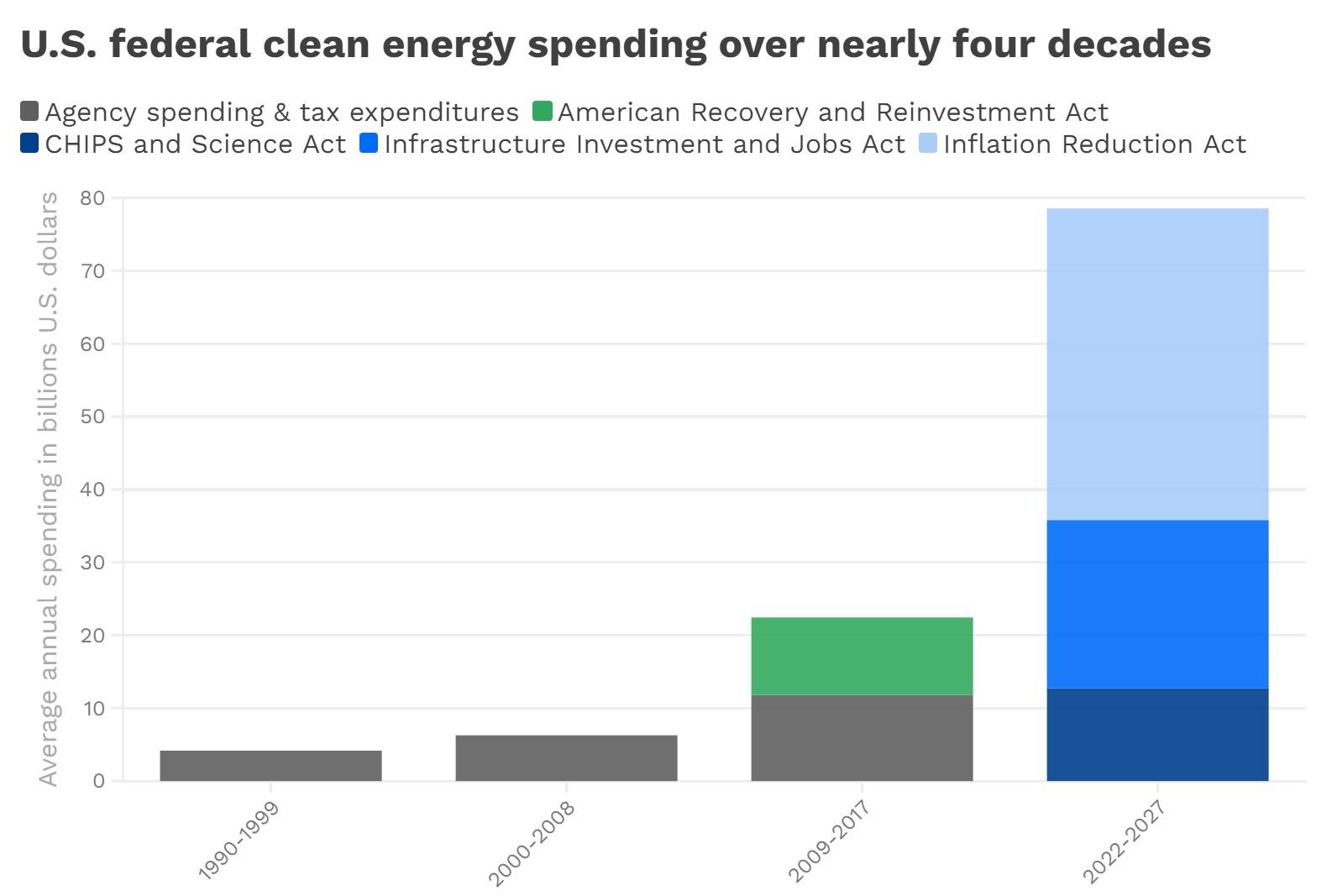
The infrastructure law (enacted last year), the CHIPS and Science Act and the Inflation Reduction Act (both signed into law this month) combined mean U.S. federal spending on cleantech over the next decade will likely be at least 3.5 times recent levels and 15 times levels seen in earlier decades, according to a recent report by the nonprofit RMI (see above chart).
“It’s not just the scale of the spending, it’s how strategically it’s being spent,” Lachlan Carey, co-author of the study and a senior associate at RMI, said in an interview with Cipher.
In the report, Carey and co-author Jun Ukita Shepard use common nouns to describe the different roles the new laws are taking on.
They liken the CHIPS and Science Act, which pours billions into research and development in a range of areas, including climate and cleantech, as the “brains” of the operation—operation being acting on climate change.
The infrastructure law is the backbone, providing the initial deployment and physical backbone needed to scale up new technologies.
The Inflation Reduction Act is the engine (presumably not one powered by fossil fuels!) that drives investment growth and stimulates more demand.
In other words, the whole is greater than the sum of the parts.
Although the last few decades of protracted and failed climate debates in Washington, D.C., have been hard, the harder part begins now: successfully deploying the laws.
Carey flagged some potential pitfalls, including the fact the U.S. may still not dominate in all cleantech manufacturing areas due to fundamental differences in processes, such as China’s dominance in solar photovoltaics.
He also said that any increase in protectionist policies—such as tariffs on dirtier products—could raise the cost of new technologies, the opposite of what needs to happen.
The need to build a lot more clean energy infrastructure—a topic we cover a lot at Cipher—is also not directly addressed in these laws. Congress is set to consider a proposal on this topic in September.
The ultimate success of this trifecta of laws will rest on everyone outside of Washington, Carey said.
“One thing we couldn’t capture effectively in that chart is the extent to which this funding will leverage multiples of private investment,” Carey said. “The real success of these initiatives is how much they are picked up by the private sector and how much they run with it.”
A couple of important caveats about the chart:
The annual averages for the three laws passed over the last year include both appropriations and authorizations, and the CHIPS data is based on authorizations (which sets the amount of money that can be spent), not appropriations (which actually doles out the money).
The chart also doesn’t include agency spending and tax expenditure estimates for 2022-2027 due to the potential of overlap in the new laws, which means the data for that period could be undercounted.