Reducing contrails could be a surprisingly effective climate solution
Voices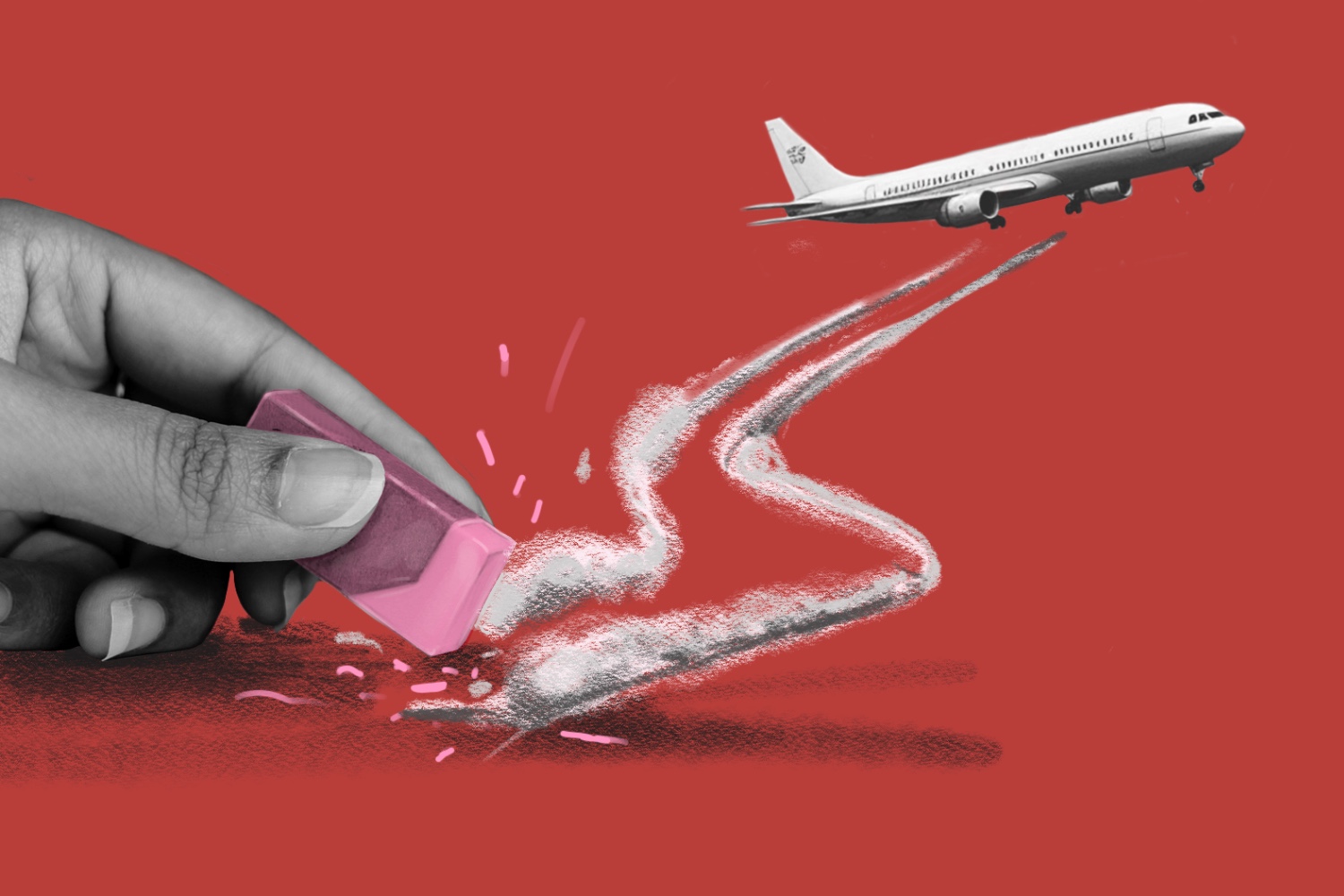
Not all opportunities to address climate change are created equal.
Some sectors of the economy, like electricity, have relatively easy-to-address greenhouse gas emissions. Other sectors, including aviation, are often considered more challenging to decarbonize. But even within aviation, some emissions are easier to reduce than others.
Consider contrails, the white lines that sometimes form in the sky behind airplanes, which are created when soot and water vapor from aircraft engines condense into artificial clouds. Individual contrails are small and don’t have much of a climate effect. But sometimes they spread out into a hazy layer of wispy, delicate clouds known as cirrus clouds. The problem is that these induced cirrus clouds are composed of large ice crystals that prevent heat radiation from escaping the atmosphere and reaching space, so they contribute to a ‘greenhouse effect’ just like CO2.
Overall, the Intergovernmental Panel on Climate Change (IPCC) estimates contrail-induced cirrus clouds may be warming the Earth as much as all of the CO2 emitted from aircrafts in the entire history of aviation.
The wild thing about these contrail clouds is they might be relatively easy to avoid. Many studies have shown moving a small percentage of flights by about 2,000 feet in the sky could keep them out of the high-humidity areas most prone to forming the worst cirrus clouds. In practice, this would work the same way airlines currently predict and avoid the areas with the most turbulence. Making this change for contrails could cut the climate impact of aviation in half, at very low cost.
How cheap exactly? Researchers at Breakthrough Energy (which also supports Cipher) and Imperial College recently estimated the cost of avoiding persistent contrails and compared that with the climate benefits. When put into “carbon dioxide equivalent” terms, they found the cost would be about $1 to $2 per metric ton of CO2-equivalent (tCO2e).
The United States Environmental Protection Agency estimates the value of avoiding one tCO2e of emissions at $190. By this math, the benefits of contrail avoidance may exceed 100 times its cost. We don’t know of any other opportunity to address a meaningful fraction of global warming so cheaply.
A reason for delay, or an excuse?
Despite the estimated ease and relatively low cost, no major airlines are currently avoiding contrails.
Uncertainty around the exact impact of contrails is an oft-cited reason.
Many of us remember that, for many years, fossil fuel companies claimed the science of global warming was too uncertain to take action to reduce emissions. There was (and still is!) scientific uncertainty over the exact amount of warming that will occur, but a scientific consensus did exist that greenhouse gases were warming the planet. And as more evidence accumulated, that scientific consensus only deepened.
Yet uncertainty was given as a reason to delay action. The result is a hotter planet; 2024 is “virtually certain” to be 1.5 degrees Celsius hotter than before the onset of the Industrial Revolution.
We don’t want to get into a similar situation when it comes to the warming effect of contrail-induced cirrus clouds. Yes, scientific uncertainty persists around the exact amount of warming that occurs as a result of contrails, but an overwhelming scientific consensus (as represented by the IPCC) agrees contrails are contributing to global warming.
If the reluctance to act in the face of uncertainty persists, the outcome is likely to be the same — an unnecessarily hotter planet — when the excess heating caused by contrails could have been avoided at very low cost.
Uncertainty might be a good excuse for delay but uncertainty also means things could be worse than currently thought, so it is not a good reason for delay.
Overall, the biggest factor underlying delay is that little economic motivation exists at this time for airlines to avoid contrails, and commercial airlines are obligated to try to maximize return to their stockholders.
We think this should change. Since the costs of avoiding contrails are so low, there might be ways to directly pay airlines to avoid them.
We see big reasons to lean into contrail avoidance, even beyond the obvious and important reduction in global warming. One is in public perception of air travel: contrails are sky graffiti, advertising the climate impact of aviation.
Another is that contrail avoidance is climate action people could see and possibly even feel in their own lifetimes; preliminary work suggests eliminating contrails could reduce European summer warming by about a third.
We need to do hard work to bring the climate impact of our modern economy down to zero. But while we are trying to do the hard stuff, we can also grab some low-hanging fruit — no matter how high in the sky it may be.
Editor’s note: Caldeira is a senior scientist at Gates Ventures and Orca Sciences is hosted by Gates Ventures, which is owned by Bill Gates, who also founded Breakthrough Energy. Breakthrough Energy has a contrails project, which Caldeira and McKay both helped to start.