Progress under a microscope at New York Climate Week
Latest News
NEW YORK CITY – Last week, thousands of climate and clean energy nerds descended on this city, attending close to a thousand events across the concrete jungle.
New York Climate Week, which ran from September 22 until September 29 this year, is a major annual gathering full of networking, lectures, workshops and much more. Coinciding with the United Nations General Assembly, it often sets the scene ahead of a busy fall that culminates in the U.N.’s annual climate conference, scheduled for this November in Baku, Azerbaijan.
Cipher’s team was on the ground in the Big Apple, moderating panels about offshore wind and green industry, attending roundtable discussions and networking with folks in the climate space.
In all the chaos, here’s what stood out to our reporters at New York Climate Week 2024.
Key takeaways:
- Biden on Trump on climate: The possibility of former President Trump winning in November’s election and following through on his vows to gut the Biden administration’s key climate law, the Inflation Reduction Act (IRA), hung like the sword of Damocles over many Climate Week events. President Biden, speaking at the Bloomberg Global Business Forum last week, promoted the IRA’s benefits and warned of a second Trump presidency. Trump’s “denial of climate change condemns our future generations to a more dangerous world. And by the way, windmills do not cause cancer,” said Biden, responding to an inaccurate claim Trump has made. — Cat Clifford

Vijay Vaitheeswaran of The Economist and John Kerry, former U.S. Climate Envoy and Secretary of State, at an Aspen Ideas Festival event at New York Climate Week in September 2024. Photo by Jillian Mock.
- Geoengineering skepticism: John Kerry, former U.S. Climate Envoy and Secretary of State, expressed skepticism at deploying a controversial technology called solar geoengineering, which would involve releasing a pollutant — sulfur dioxide — into the stratosphere to (at least temporarily) cool global temperatures. Its appeal lies in the potential of it being a surprisingly affordable way to ward off the worst impacts of extreme weather, but it’s highly contentious for several reasons, including the potential for unintended consequences. When asked about it at an Aspen Ideas Festival event, Kerry said it could “destroy the planet” and give the false impression that society can keep polluting. He urged focus on reducing emissions through clean-energy technologies. He did say he wasn’t opposed to research into geoengineering, though. — Amy Harder
- Headwinds abating: Declining interest rates are vital for renewable energy, Mads Nipper, CEO of the world’s largest offshore wind producer Ørsted, said during a fireside chat I conducted at a Dynamo Energy Hub event. Over the last year, the Danish firm has written off billions of dollars in canceled offshore wind projects in the United States and has pulled back from potential investments in electric fuels, hydrogen and floating offshore wind. But with the Federal Reserve lowering interest rates earlier this month, the industry is getting back on firmer footing, Nipper said, and Ørsted is now moving ahead on other U.S.-based projects with more capital discipline. “We strongly believe in the U.S. offshore renewables market,” Nipper said. — Amy Harder
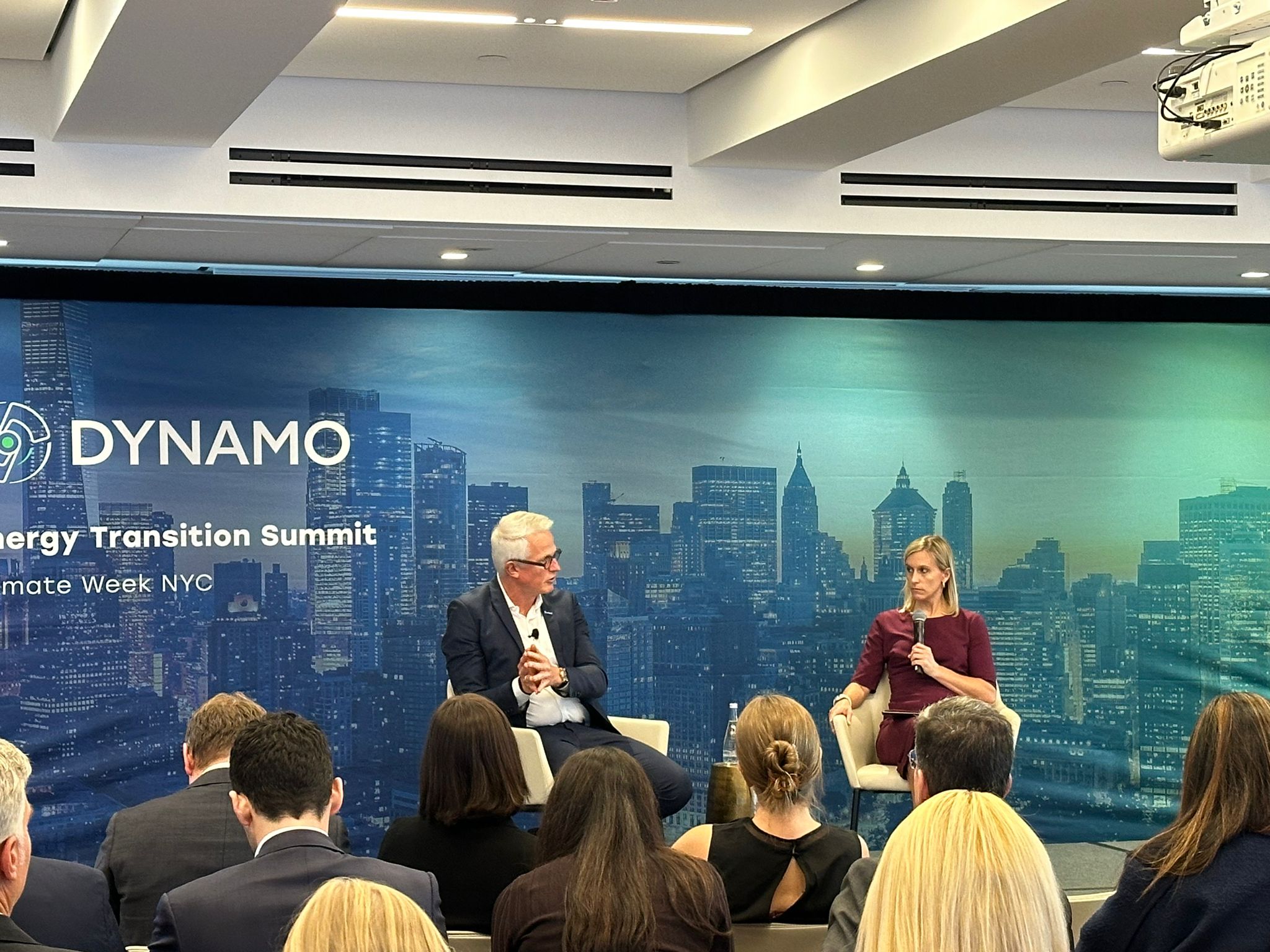
Mads Nipper, CEO of Ørsted, in conversation with Amy Harder, executive editor of Cipher News, at the Dynamo Energy Hub event during New York Climate Week in September 2024. Photo by Anca Gurzu.
- Protest interruption: A New York Times sponsored Climate Week event was disrupted and moved online for its last hour when anti-fossil fuel protestors took over the stage as Vicki Hollub, the CEO of Occidental Petroleum, entered. Hollub was immediately escorted off stage as the demonstrators unfurled a banner and chanted anti-fossil fuel slogans peacefully. Security officials cleared the auditorium of attendees. Uniformed New York City police cleared the stage after about 10 minutes and the in-person talk by Hollub in front of the live audience was canceled. — Bill Spindle
- Water-energy nexus: As climate-fueled droughts increase and freshwater resources dwindle, countries need to remove salt from seawater to produce clean fuels like renewable hydrogen. “Seven out of the ten most water stressed countries in the world are in the Middle East and North Africa,” Farid Al Awlaqi, CEO of TAQA, United Arab Emirates’ national energy company, told attendees at Dynamo’s summit. — Amena H. Saiyid
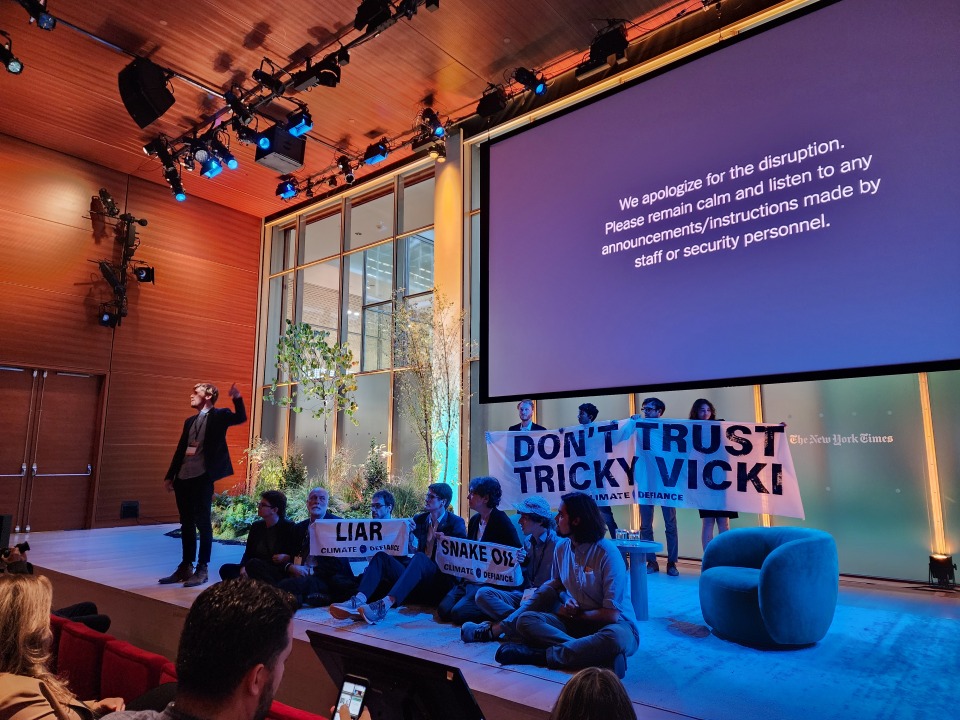
Protesters interrupted a New York Times event at New York Climate Week in September 2024 before Vicki Hollub, the CEO of Occidental Petroleum, was going to speak to the audience. Photo by Cat Clifford.
- Food focus: Food and agriculture are responsible for 20% to 30% of global greenhouse gas emissions. Efforts are underway, like The Agriculture Innovation Mission for Climate, to encourage the sort of innovation and ingenuity in the agriculture and food sectors that has driven clean energy advancement over the past few decades. “If we’re going to feed the world, we’re going to have to increase agricultural productivity at a time when it’s going to be more difficult because of the changing climate,” Tom Vilsack, secretary of agriculture for the Biden administration, said at a Council of Foreign Relations gathering where the effort’s flagship report was released last week. — Bill Spindle
- Nuclear excitement: Surging demand for carbon-free electricity has put nuclear energy in demand again for the first time in decades in the United States. “Nuclear is having its second? Third? Fourth? Renaissance, right?” said Caroline Golin, global head of energy markets development and innovation at Google at the Dynamo Energy Hub event. But the sector will need financing; in a joint statement, many of the world’s largest financial institutions, including Bank of America, Barclays and Goldman Sachs, expressed support for the nuclear industry. — Cat Clifford

A panel discussion at the Dynamo Energy Hub event at New York Climate Week 2024. From L to R: Rich Powell, CEO, Clean Energy Buyers Association; Petter Skantze, VP of infrastructure development, NextEra Energy Resources; Gregory J. Murphy, EVP, business services and general counsel, Nucor; Lou Martinez Sancho, CTO, EVP, president R&D and innovation, Westinghouse; Caroline Golin, global head of energy markets development and innovation, Google. Photo by Cat Clifford.
- Trade and industrial policy: The European Union uses a carbon border adjustment mechanism (CBAM) to put a price on carbon-intensive goods entering the bloc. The United States will likely mirror those measures in coming years, Mark Carney, United Nations special envoy for climate action and finance, said at the Earthshot Prize ceremony organized by Bloomberg Philanthropies. As integrating trade and industrial policies becomes one of the main ways to drive investment in clean technologies, he said, “the world will get used to ‘what is the delivered carbon in a good or service.’” — Anca Gurzu
- Electricity in Africa: Providing modern energy access to hundreds of millions of Africans by 2030 will require a bottom-up approach where local communities and national governments shape their own innovative electricity systems. That was one of the main messages at an event focused on Mission 300, a partnership between the World Bank, the African Development Bank and others to bring electricity access to 300 million people in Africa by 2030. The continent is home to nearly 83% of the world’s unelectrified population. “It won’t be acceptable for us not to achieve this,” said Damilola Ogunbiyi, CEO of Sustainable Energy for All, another partner in the project. — Anca Gurzu
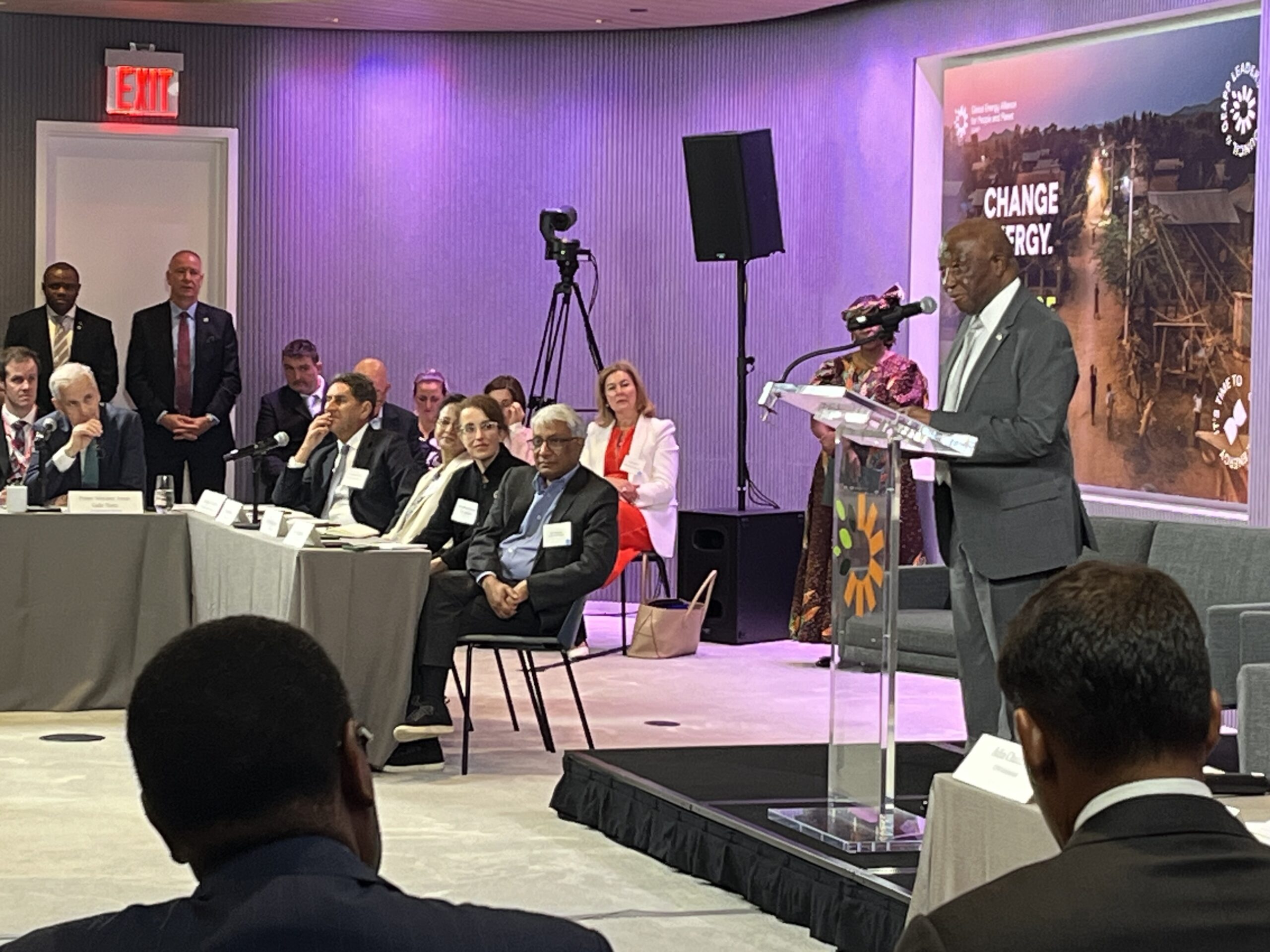
Joseph Boakai, president of Liberia, speaks in front of the opening of the Global Energy Alliance for People and Planet’s Leadership Council at New York Climate Week in September 2024. He called for an acceleration of energy access in his country. Photo by Jillian Mock.
- Green steel demand: Currently there are no factories producing green steel on a commercial basis, Bryan Fisher, managing director of RMI’s climate-aligned industries, said on a panel I moderated about cleaning up industry at RMI’s flagship event. That said, a handful of commercial-scale facilities are being built or retrofitted for this purpose. Last week, RMI announced that a coalition of companies, including Microsoft and Amazon, are looking to purchase one million metric tons of green steel by 2028, an effort to boost demand and stimulate production. — Amena H. Saiyid
- Job training: Skilling and job training, particularly in the technology and artificial intelligence sectors, were a major focus of a well-attended event sponsored by Salesforce, the huge U.S. software company, during Climate Week. New York City aims to make green jobs a mainstay of the local economy, Abby Jo Sigal, executive director of the mayor’s Office of Talent and Workforce Development, told the group. “Because if you don’t, that means you might get left out of not just the green economy, but the economy overall,” she said. — Bill Spindle