Plotting a new clean industrial revolution
Latest NewsTop takeaways from London climate tech conference

LONDON — In the country that gave rise to the world’s Industrial Revolution, at a venue known for the historical trading of tobacco and other commodities, more than a thousand people from across the world’s climate solutions industry gathered last week to pursue what organizers called a “clean industrial revolution.”
Cipher journalists were on the ground with roughly two-dozen other reporters to cover the second-ever Breakthrough Energy Summit. The first was held in 2022 in Seattle, home of Bill Gates, who founded Breakthrough in 2015 to complement his work as co-chair of the Bill and Melinda Gates Foundation.
(Cipher is supported by Breakthrough Energy but retains editorial independence over its coverage.)
Here are some key takeaways:
- It’s all about scale: A primary theme of the summit was understanding the scale of the energy transition and, correspondingly, the enormity of the solutions needed to address the challenge. “It’s important that we have clear eyes and understand the magnitude of the challenge that’s in front of us. There’s no sugar coating this,” Eric Toone, the chief technology officer of Breakthrough Energy, said in a TED-talk style speech to open the summit. “There is no easy button to push here. It’s hard work, and it’s going to take a long time,” he said. In his opening-day remarks, Gates echoed this sentiment. “We’ll be measured by scale,” he said. “The amount of emissions abated is kind of your final grade.” Read more. — Cat Clifford
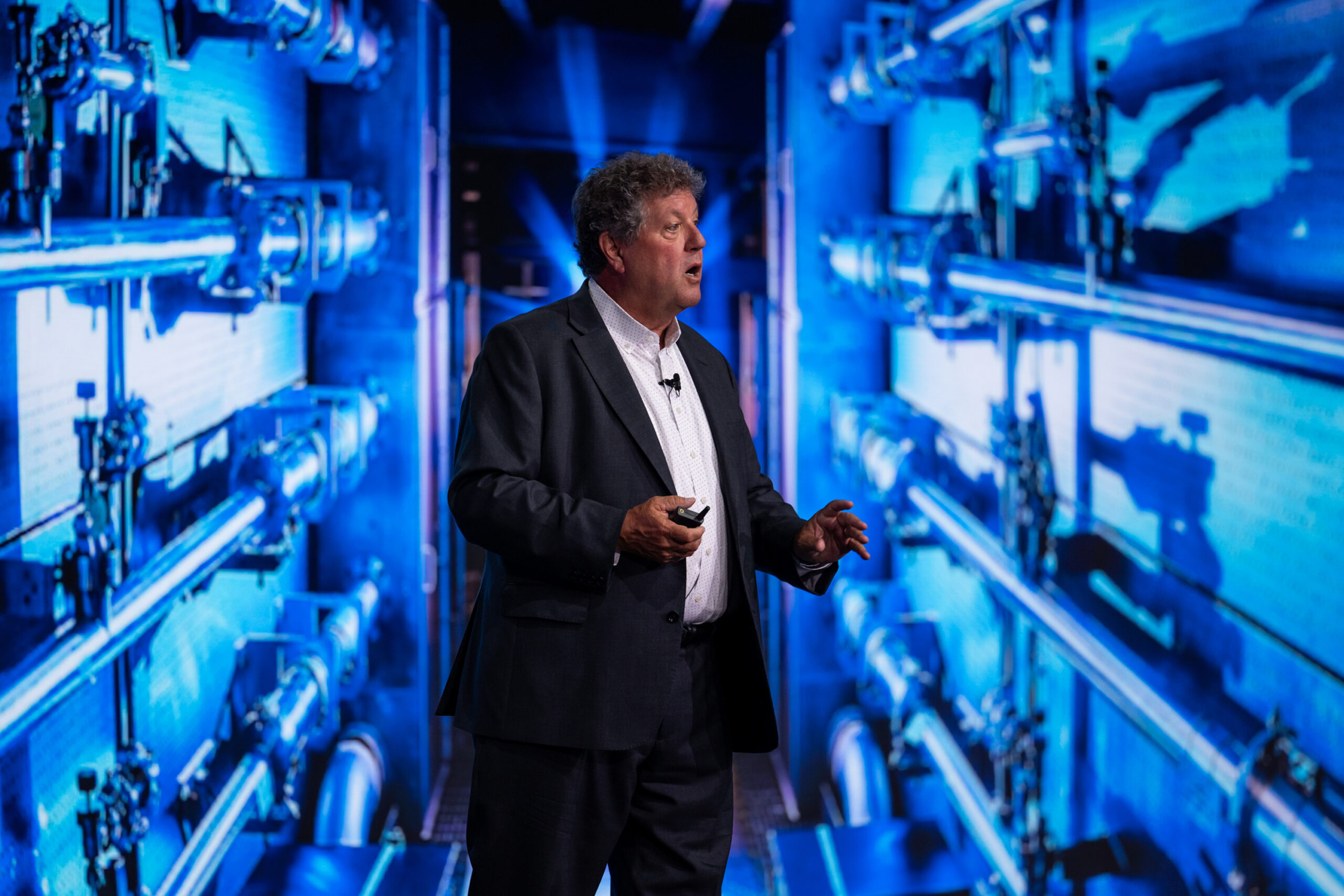
Eric Toone speaks at the Breakthrough Energy Summit in London on June 26, 2024. Photo by Breakthrough Energy.
- A new, clean industrial revolution: At the opening plenary, Breakthrough Energy executive director Rodi Guidero welcomed attendees to the United Kingdom, “the birthplace of the Industrial Revolution,” he said, referring to the period in the 18th century when rural, farm-based economies transitioned to more urban societies defined by the coal-powered steam engine and mechanized factory production. Fossil fuel energy drove the Industrial Revolution’s progress and prosperity; today it drives the greenhouse gas emissions behind global climate change. “So, we have to bring about a clean industrial revolution as quickly as possible. It’s our responsibility, especially as our energy demands go up,” Guidero said. That call to action underpinned the entire conference. — Cat Clifford
- Facing political headwinds: Despite recent political and economic obstacles, the energy transition needs to accelerate, with innovation playing a central role, three policy and financial leaders said at a panel on leadership. Progress toward decarbonization is picking up, but the challenges are also growing, said John Podesta, a climate advisor to United States President Joe Biden, in comments echoed by Mario Draghi, a former prime minister of Italy and former head of the European Central Bank. They were joined by Noel Quinn, chief executive of the global bank HSBC, who warned: “We cannot reinvent today’s industrial landscape simply through a process of evolution. There has to be an element of revolution in the innovation.” Read more. — Bill Spindle.
- IRA update: Podesta, a key architect of the 2022 Inflation Reduction Act climate law in the U.S., said the IRA is not only pushing U.S. decarbonization forward but also bolstering the credibility of the U.S. as a leader globally: “What the IRA did was show the U.S. is really committed” to the president’s pledge to cut U.S. emissions by 50 to 52% by 2030. “We’ve seen a huge surge of investment in the cleantech sector.” — Bill Spindle

Panel discussion at the Breakthrough Energy summit on June 26, 2024 in London. From L to R: Amy Harder, executive editor of Cipher News; Noel Quinn, chief executive of HSBC; John Podesta, climate advisor to U.S. President Joe Biden; and Mario Draghi, former prime minister of Italy and former head of the European Central Bank. Photo by Anca Gurzu.
- The business case for the European Green Deal: The European Union is set to embark on a new five-year political cycle with a revamped pitch for its trademark European Green Deal: it’s good for business. “The focus of our policy-making has shifted very much to the business case of the transformation,” said Kerstin Jorna, director-general for internal market and industry in the European Commission, on a panel about the state of climate action. Competitiveness concerns have topped the EU agenda in recent months, with a much-awaited report later this summer from Draghi, the former Italian prime minister, intended to provide some solutions. — Anca Gurzu
- AI could accelerate climate solutions: Artificial intelligence will accelerate climate solutions and use a tremendous amount of power — a double-edged sword discussed at a packed breakout session. Vinod Khosla, one of the world’s leading venture capital investors in new technologies, including both climate tech and AI, expects an “AI scientist” in the next year or two. “And then we will have real solutions to climate because that scientist is what we need to solve hard problems,” he said. Gates said earlier in the day he expects AI to be a “very significant” accelerant of climate tech. — Cat Clifford
- A plan for power grids: To move all the world’s power grids away from fossil fuels and expand those grids to provide more electricity, we need more visibility into those systems and their decarbonization plans. One solution is to build an open-source platform that integrates existing grid planning models and allows for better integration of clean energy sources, said Rajeev Ram, partner at Breakthrough Energy Ventures. Ram used a metaphor to explain the platform’s purpose: When summit attendees prepared to leave London, they would know their destination — Heathrow Airport — but not exactly how to get there. The open platform would allow for detailed, step-by-step planning to give stakeholders more confidence in their systems and investments. Think of it as the “operating system for grid decarbonization,” Ram said. — Anca Gurzu
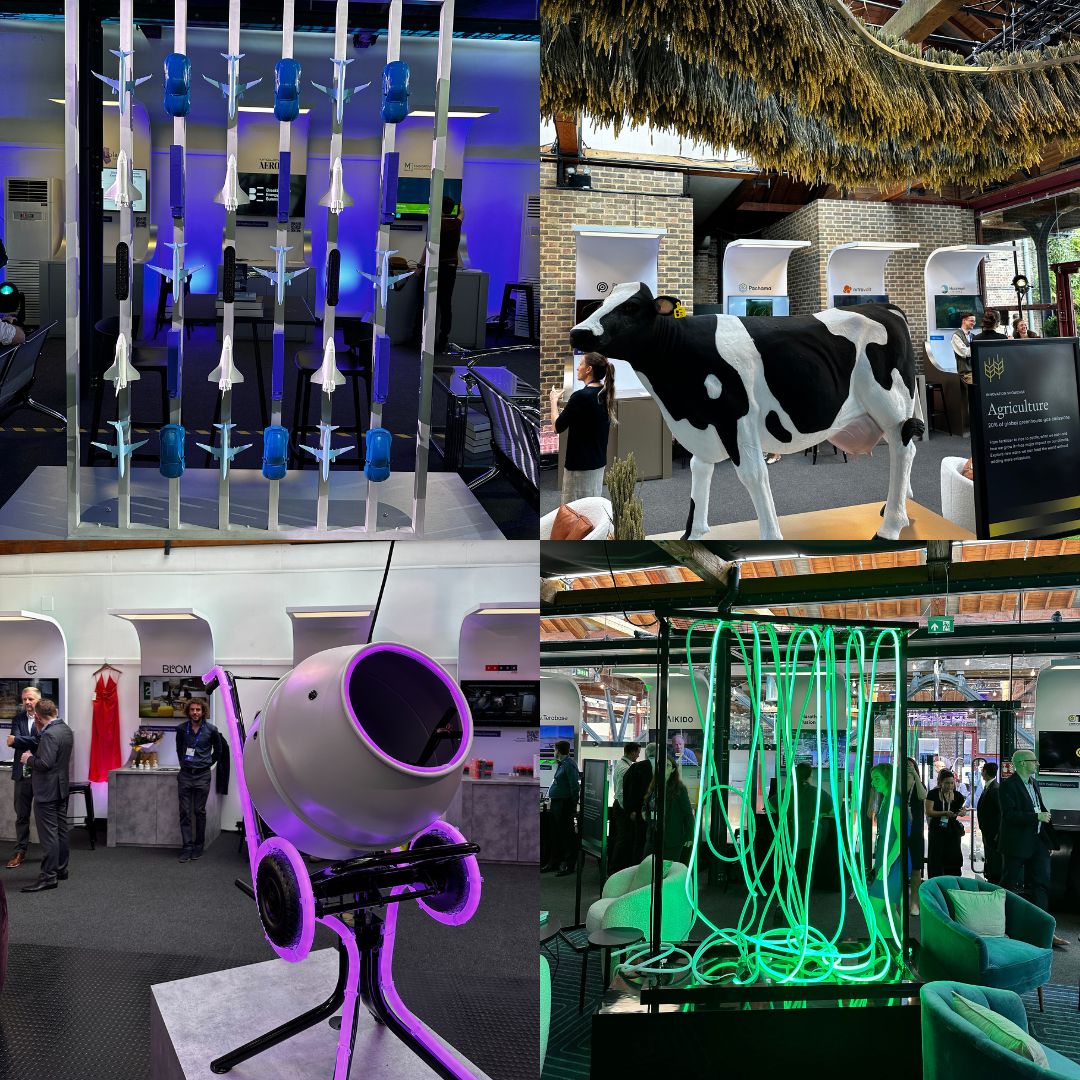
Photos of displays by cleantech companies at the Breakthrough Energy summit in London on Tuesday, June 25, 2024. The photos reflect several major decarbonization challenges: transportation (mini cars, trains and planes), agriculture (a life-sized toy cow), electricity (power cables) and manufacturing (a psychedelic cement mixer). Photos by Anca Gurzu.
- Calling in the private sector: Private sector investments will be key for securing the trillions of dollars needed for the energy transition, said former U.S. special presidential envoy for climate John Kerry. “I believe private sector is the entity that is going to solve this problem,” Kerry told a capacity crowd on the summit’s second day. “No government has enough money to do this.” He said the marketplace is already decisively shifting to clean energy investments, pointing out that last year more investments went toward clean energy than fossil fuels. “It is happening, the marketplace is changing,” Kerry said. Read more. — Anca Gurzu
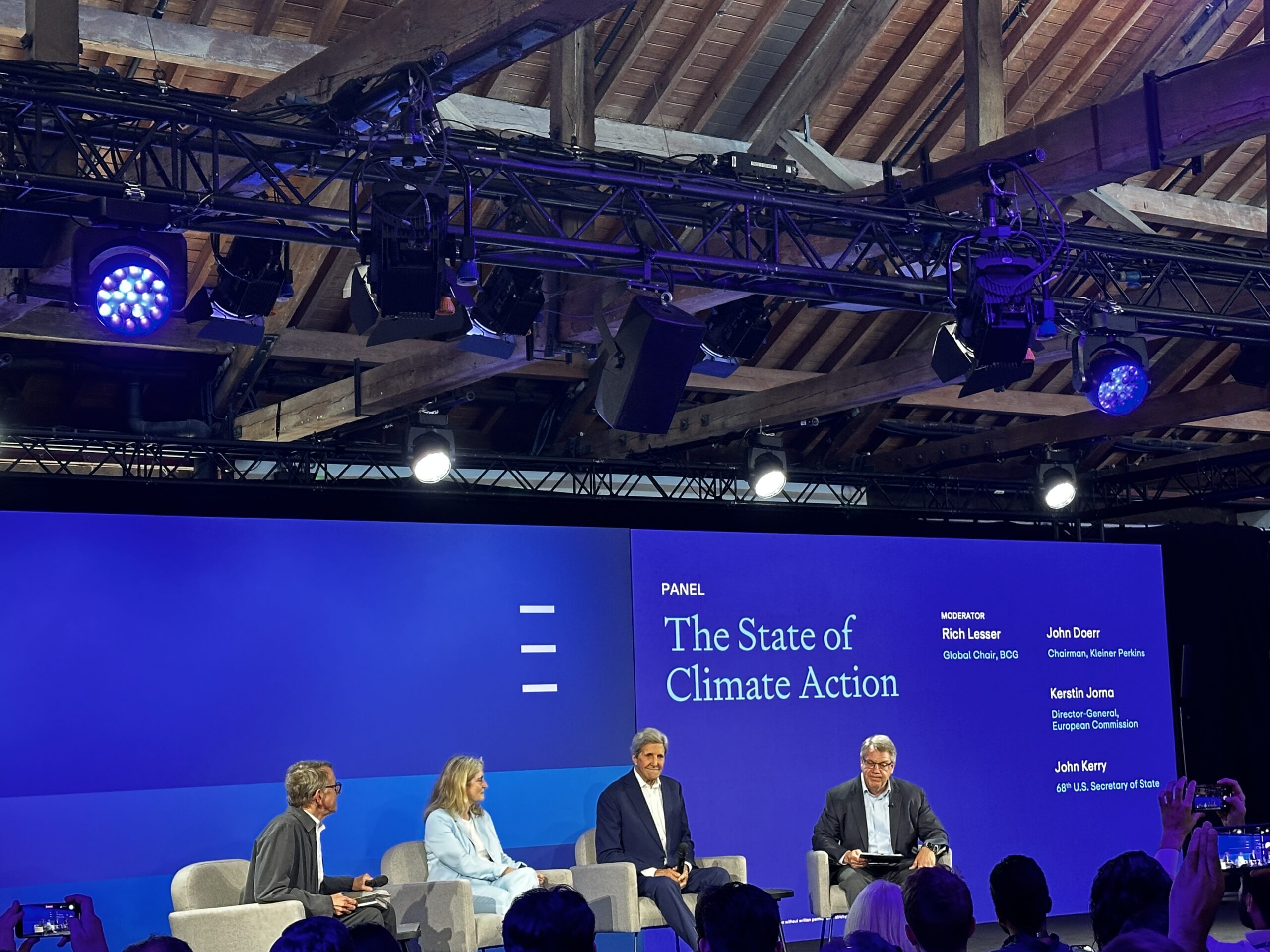
From L to R: John Doerr, chairman of venture capital firm Kleiner Perkins; Kerstin Jorna, director-general of the European Commission; John Kerry, former U.S. climate envoy and secretary of state; Rich Lesser, global chair of consultancy BCG. Photo by Anca Gurzu.
- Green premium going, going… gone, at least for cement: Scaling up climate solutions often begins with overcoming the “green premium,” the additional cost of producing a clean product to replace a greenhouse-gas emitting one. That’s a huge challenge for some products, like jet fuel or steel. But for the world’s most common product — cement — that crucial goal has already been met, according to Donal O’Riain, the founder and managing director of Ecocem, a low-carbon cement company. The company worked for decades to refine a type of cement as durable and strong as regular cement with almost two-thirds of the emissions that can be produced at a low cost. “No green premium. This is competitive with existing cement that we buy every day to build our infrastructure and housing,” he told a session about buildings and infrastructure. “We use the term, traversing the ‘valley of death’ with new technologies. We’ve successfully done that. Now we face the Everest of scalability.” — Bill Spindle
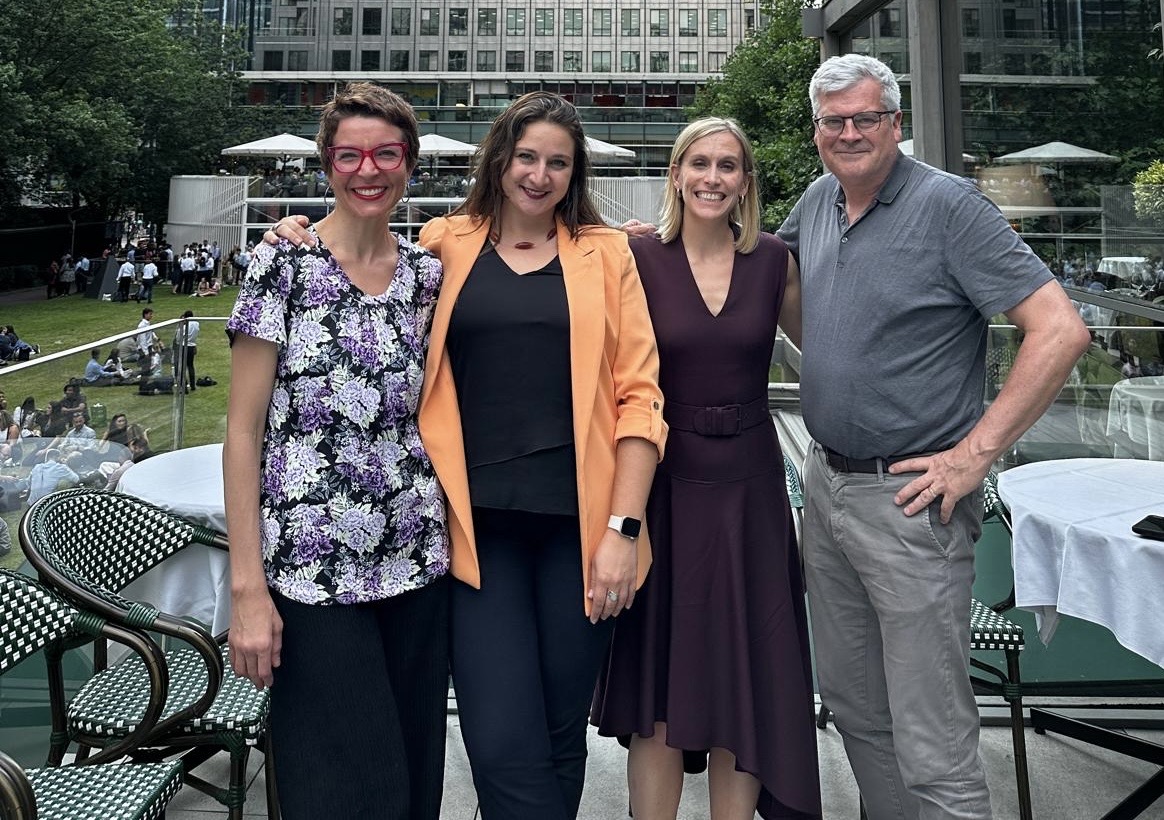
The Cipher News team on the ground in London in June 2024: Cat Clifford, Anca Gurzu, Amy Harder and Bill Spindle. Photo courtesy of the Cipher team.
Editor’s note: Breakthrough Energy supports Cipher.