How United Nations climate conferences work
ExplainersIn partnership with Encyclopædia Britannica, Cipher will be publishing occasional articles offering background and context on important climate programs, technologies and leaders. This article is the first in the series.
Conference of the parties (COP) is a generic term that refers to the governing body of an international treaty or framework convention, bringing together its members to review and update the treaty’s implementation.
Although the United Nations hosts several such conferences on various topics, including biological diversity and anti-corruption efforts, the term conference of the parties is primarily associated with the annual assembly of the main decision-making body of the United Nations Framework Convention on Climate Change (UNFCCC) — and it is this association that is the subject of this article.
The UNFCCC is a binding treaty that requires member states to reduce their emissions of carbon dioxide, methane and other greenhouse gases (GHGs), which are responsible for global warming (see also United Nations Conference on Environment and Development).
Nearly 200 countries and the European Union are parties to and bound by the UNFCCC. The treaty entered into force in 1994 and the first COP that dealt with climate issues, known as COP1, took place in Berlin in 1995.
COPs are typically held annually at different locations around the world, with the host country rotating among the five UN regional groups (that is, Africa, Asia and the Pacific, central and eastern Europe, Latin America and the Caribbean and western Europe and other states — the latter of which includes the United States, Canada and Australia).
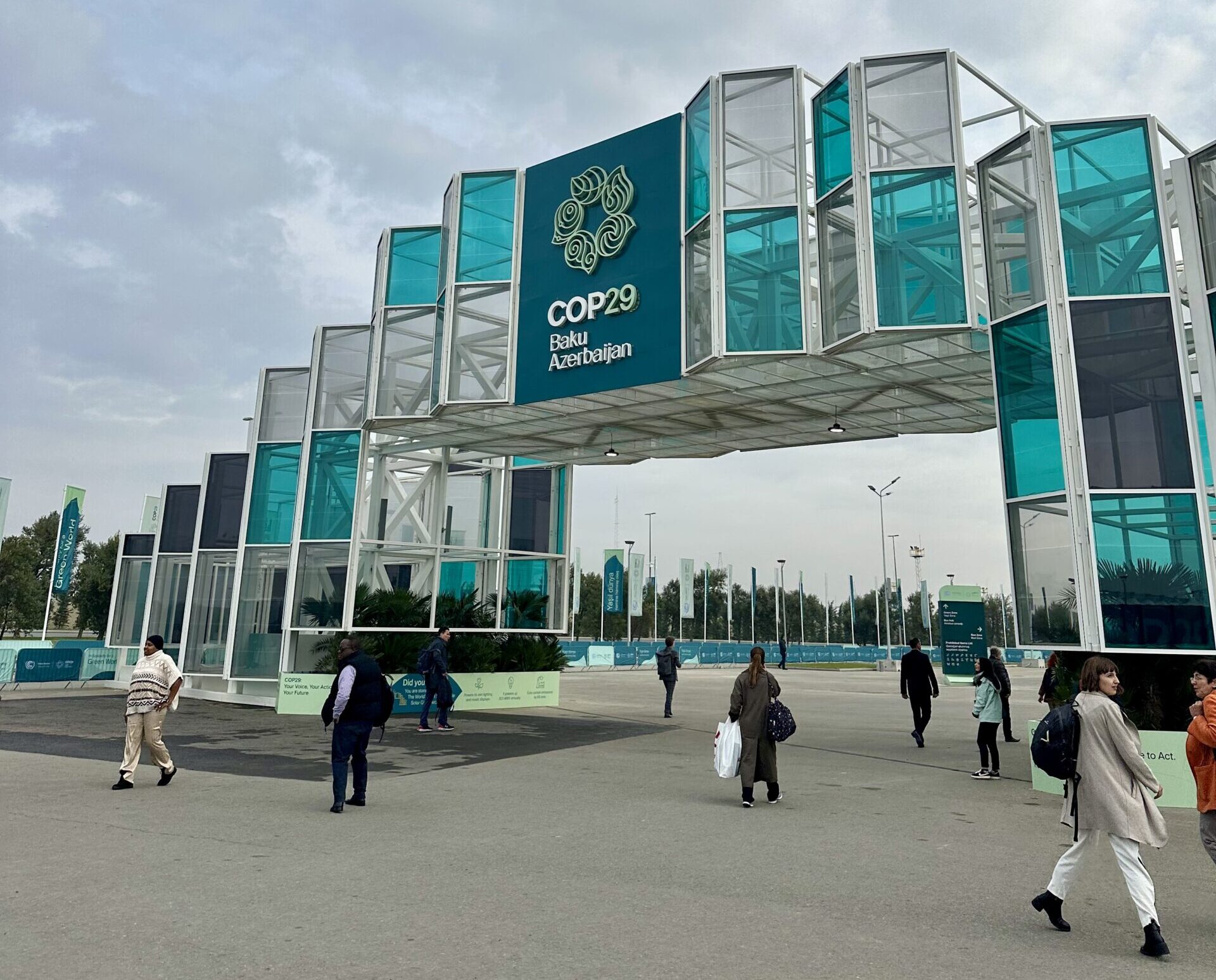
The official entrance of the COP29 summit in Baku, Azerbaijan. The different-colored glass panes are actually solar panels. A sign tells delegates that this is the world’s first sustainable solar glass arch, which powers its own lighting and music displays. Photo by Anca Gurzu in November 2024.
Structure and procedures
Each COP, which plays out over the course of about two weeks, is made up of the presidency and the attendees. The COP presidency, which is held in most cases by the host country, is responsible for leading negotiations and representing the collective voice of all parties. The attendees at a COP, in contrast, are either representatives of governments (parties) or observer organizations, which include civil society groups, researchers, businesses, financial institutions, regional governments and local communities.
COP decisions are generally made by consensus, meaning all parties must agree even if no formal vote is taken. Parties often negotiate in regional groups based on shared interests. For example, the EU negotiates as a bloc, African countries tend to speak in unison and small islands and some developing states team up to get their voices heard.
The yearly COPs try to advance a variety of issues from mitigation to adaptation and finance, but each summit often also has one core target, which ranges from an improvement to a particular process or mechanism (such as a new climate financing pledge) to agreement on a new comprehensive climate mitigation plan.
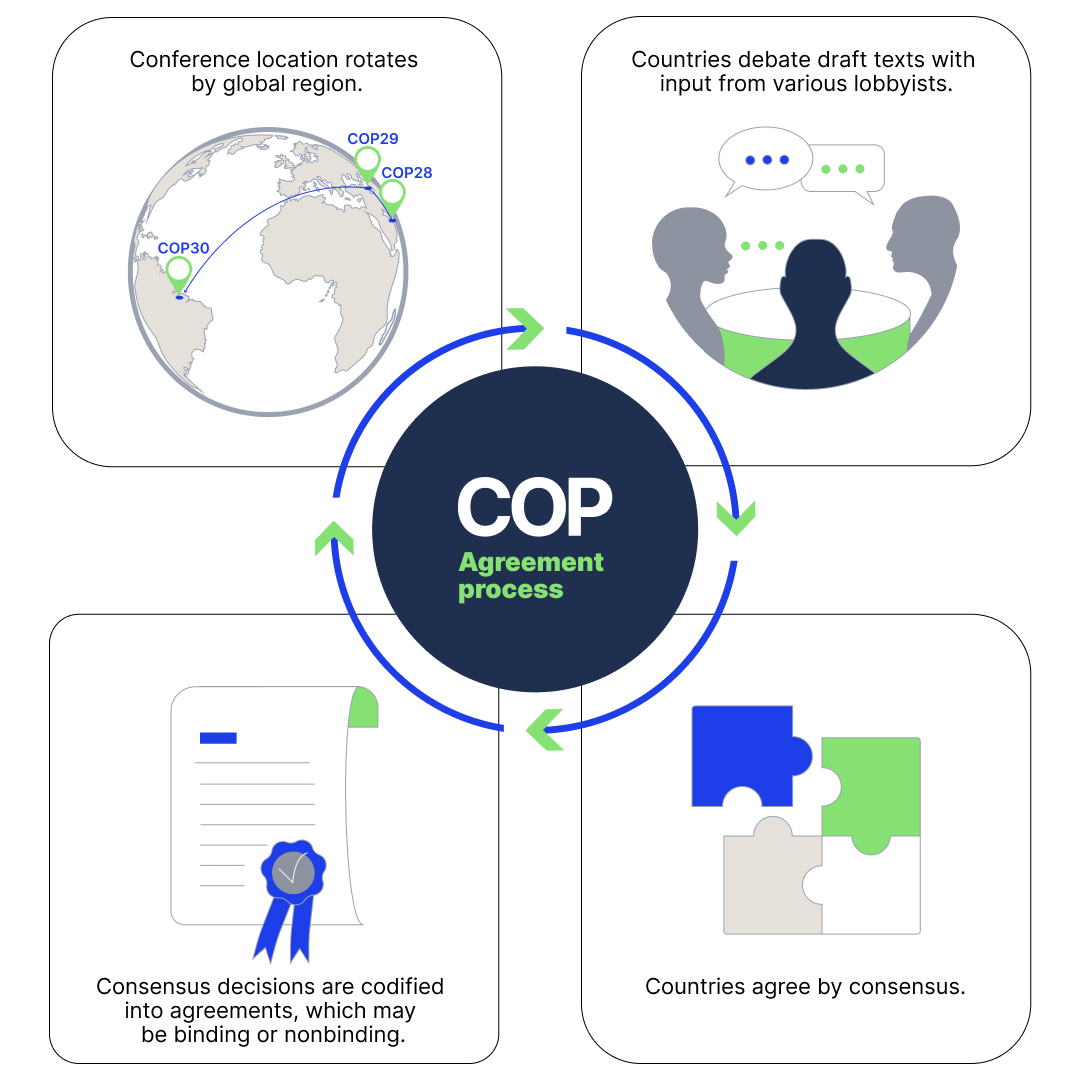
UN climate conference of the parties meetings are hosted in different locations each year. These annual meetings often involve a period of debate, where the language placed in global climate decisions is first drafted. Decisions, as well as the language that describes them, are passed by consensus before being codified into binding and non-binding agreements. Illustration by Nadya Nickels.
Negotiations begin with a draft text, which is debated and revised in various working groups and informal consultations until parties agree on a final version. The final text is submitted to a plenary session for parties to review and reach agreement. Decisions made at a COP can be binding or non-binding, depending on the type of agreement.
For example, the 2015 Paris Agreement, under which countries committed to emission reduction targets (namely, preventing global temperatures from increasing by more than 2 degrees Celsius (3.6 degrees Fahrenheit) above benchmark temperatures occurring before the start of the Industrial Revolution) and reporting requirements, is binding under international law. Parties are not legally bound, however, to meet their nationally determined contributions (NDCs) with respect to GHG emissions, which were also components of the Paris Agreement.
Outcomes at COPs may also include documents that are considered generally to be political declarations, which are also non-binding and set out various climate intentions. The language of the final text is often contentious and roundly debated, as it is seen as setting precedents. Overall, the success of any one COP largely depends on voluntary action and progress made toward global collaboration.
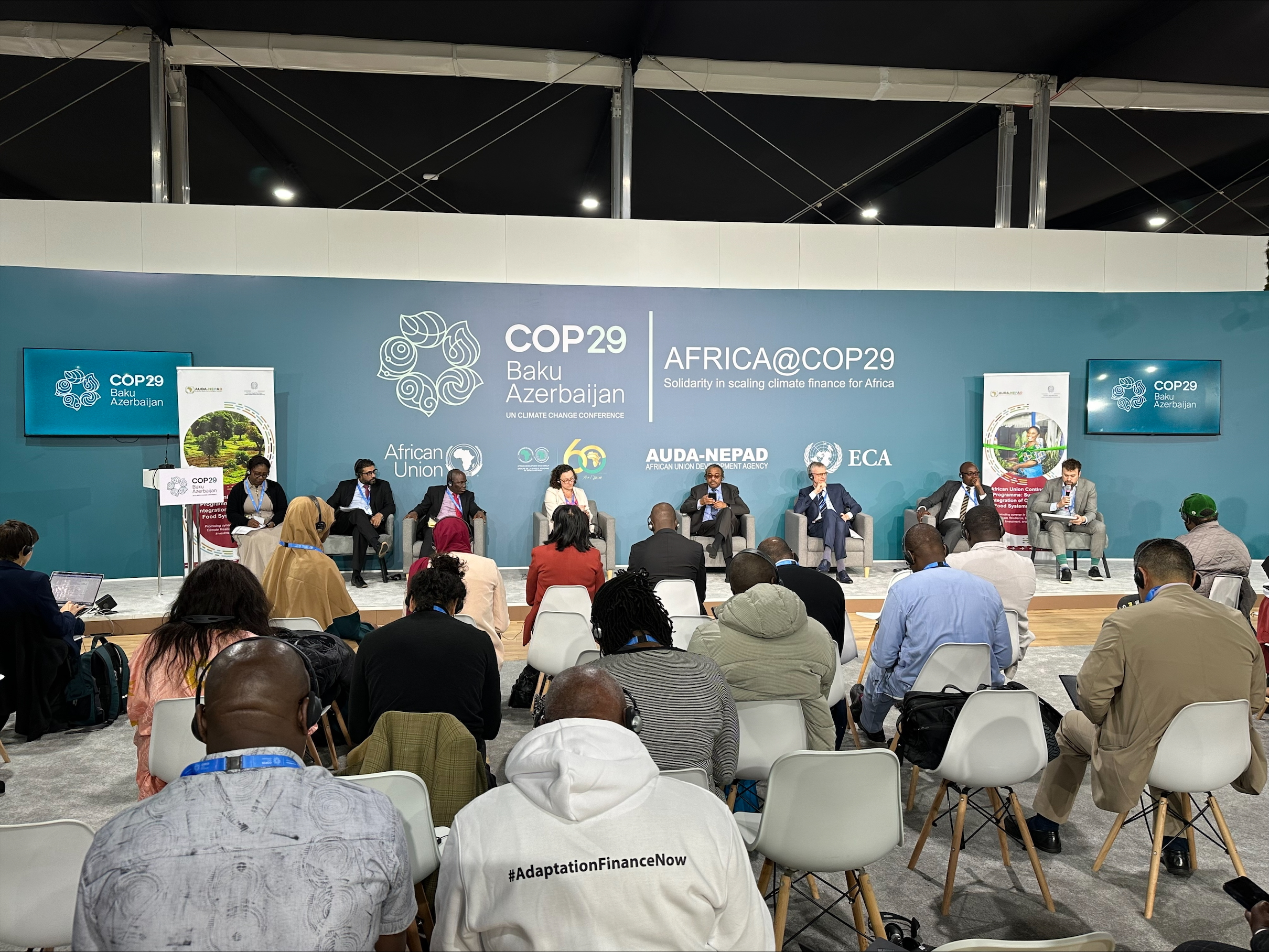
Parties often negotiate in regional groups based on shared interests at annual United Nations climate change conferences. For example, African representatives, such as those shown here at the Africa-focused pavilion at COP29 in Baku, Azerbaijan, often coordinate their policy positions with one another in order to speak as a regional bloc. Photo by Anca Gurzu, November 2024.
Role of non-state actors
Beyond the official state delegations who participate in each COP, several non-state actors such as nongovernmental organizations (NGOs) and businesses play roles in influencing negotiations through advocacy and other events without participating directly in the decision-making process.
The number of delegates attending COPs has generally been on the rise, leading to complaints that such high participation is counterproductive for reaching agreement. For example, about 38,000 delegates attended COP21 in Paris in 2015, and the number of delegates rose to roughly 85,000 at COP28 in Dubai, United Arab Emirates, in 2023. However, delegate attendance fell to 55,000 at COP29 in 2024 in Baku, Azerbaijan.
In addition, criticism has been leveled at the growing number of lobbyists for the fossil-fuel industry attending the talks. Some 2,500 were granted access to COP28, which stood about four times higher than the number of fossil-fuel lobbyists that had access to COP27 and more than the total number of official attendees from the 10 countries most vulnerable to climate change. Almost 1,800 coal, oil and natural gas lobbyists attended COP29 in Baku, which surpassed the size of the total delegations of every country at the conference except Azerbaijan, Brazil and Turkey.
Partly in response to the increasing number of non-state actors, a coalition of climate leaders and scientists wrote an open letter in November 2024 that called for the reform of the COPs to streamline decision-making, improve accountability, increase transparency, make representation more equitable and amend the selection criteria for the COP presidency to ensure that the host countries safeguard and advocate for the goals of the UNFCCC rather than on behalf of other interests.
Criticism and assessment
Each year a COP aims to improve on the progress of previous meetings and advance global efforts to slow temperature increases. Delegates often clash in their interests and requests, which, along with the activities of up to tens of thousands of other people, makes the work of such conferences intense and tiring affairs.
The greatest challenges facing the COPs have been obtaining commitments from individual countries to reduce their use of fossil fuels and providing adequate financial support to poorer and more vulnerable countries (which are those least responsible for the effects of climate change). Such financial support helps these countries adapt to changes in climate and reduce their own GHG emissions while growing their economies.
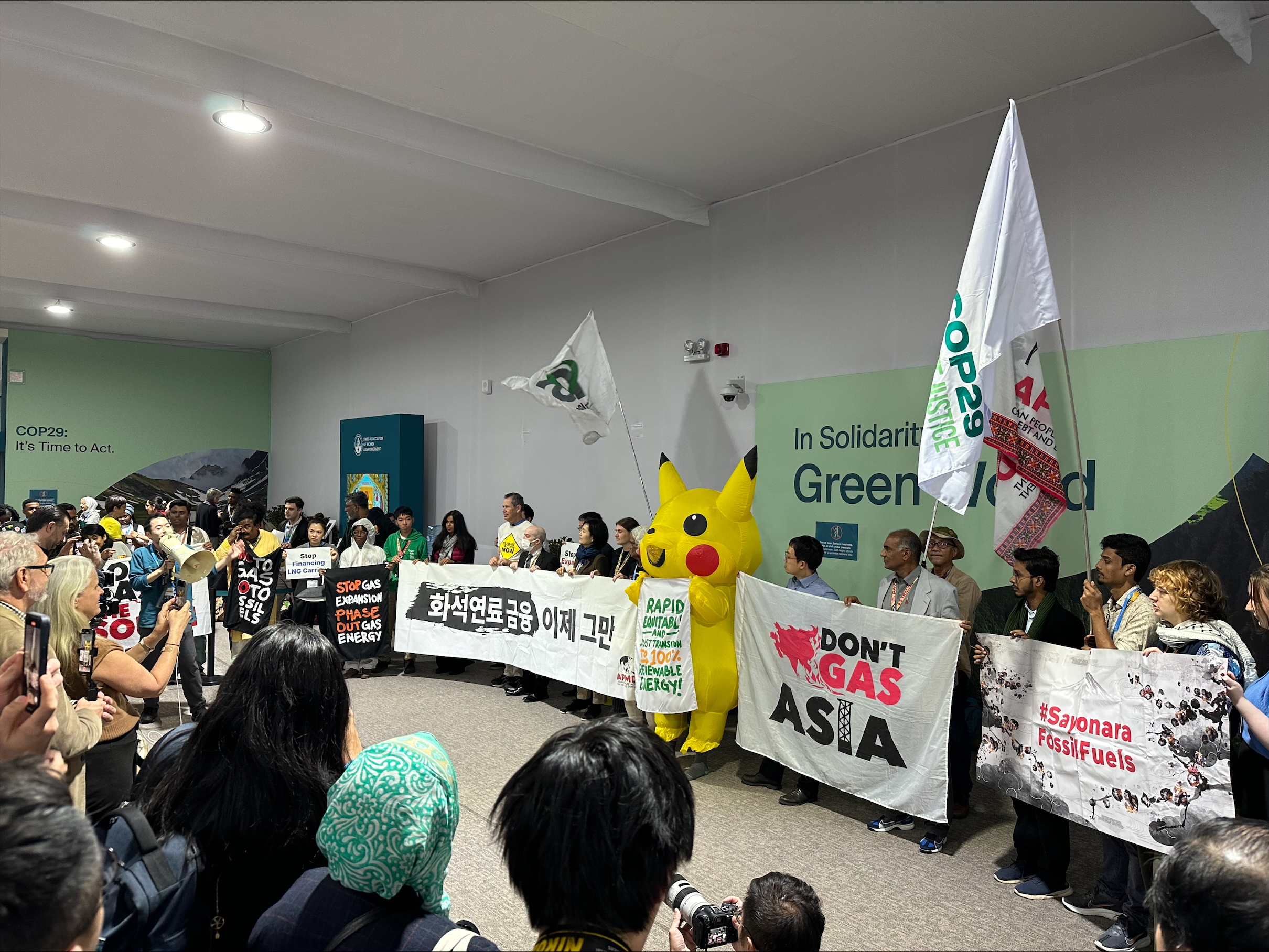
Nongovernmental groups (NGOs) and other non-state actors — such as the protesters shown here at COP29 at Baku, Azerbaijan, demanding the end of fossil fuels across Asia — advocate for the inclusion of specific policies in consensus documents and agreements. Photo by Anca Gurzu, November 2024.
COP supporters note that under the UNFCCC these meetings serve as critical forums for global climate governance that enable the world to move forward with respect to climate action through political will and compromise, despite parties’ sometimes polarizing positions. The landmark 2015 Paris Agreement — which replaced the Kyoto Protocol and greatly improved international cooperation regarding the curbing of GHGs from human activities — stands as a prime example of this dynamic.
Critics, however, charge that COPs suffer from inefficiency, slow progress and vulnerability to geopolitical tensions, all of which highlight the need for their reform.
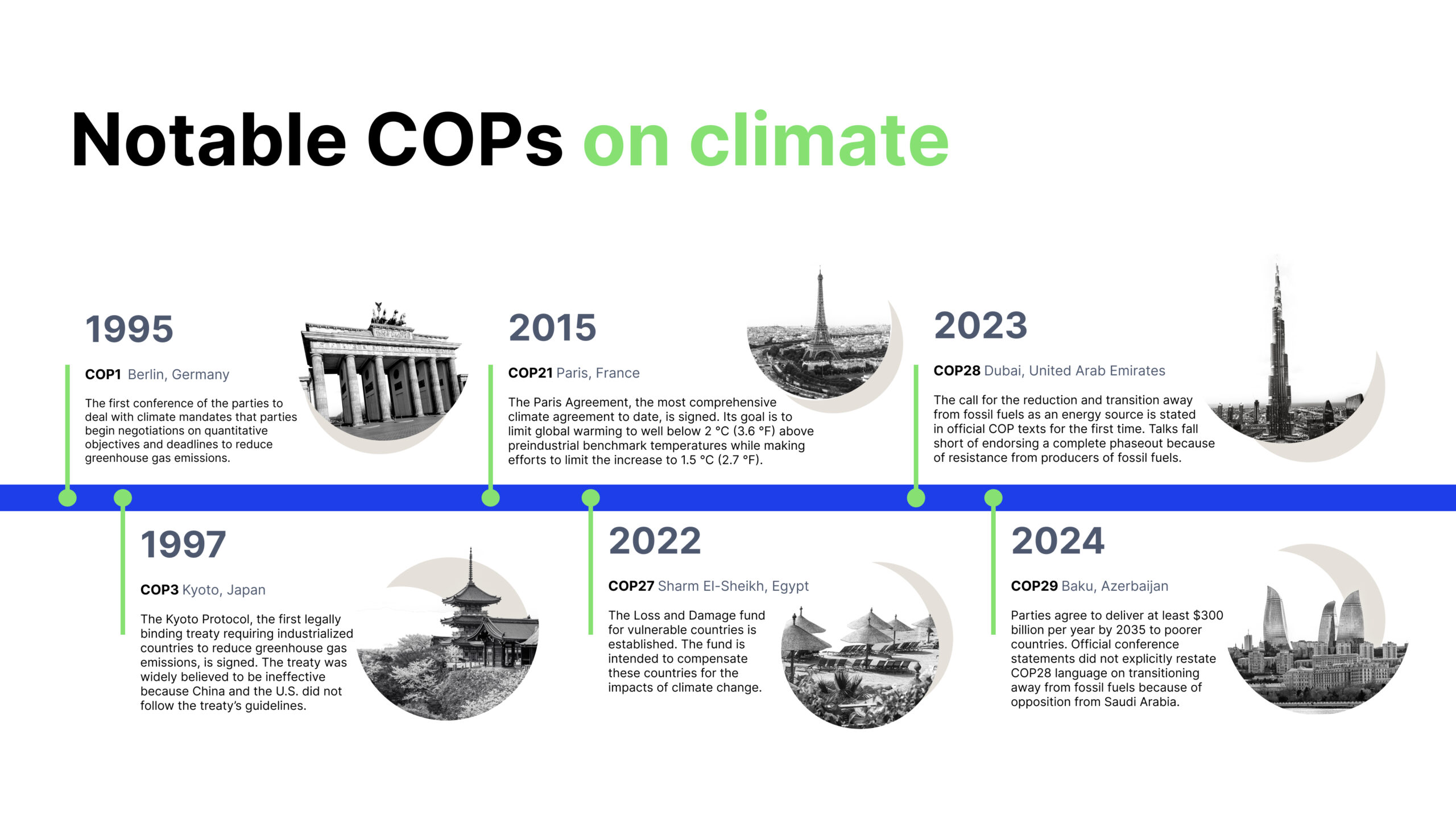
Since the first conference of the parties (COP) on climate was held in Berlin, Germany, in 1995, a handful of the meetings that followed became notable for their landmark decisions and controversies. Illustration by Nadya Nickels.