Geoengineering quantified: Heat is deadlier than air pollution
Explainers
As the Earth’s temperature keeps rising, scientists and entrepreneurs around the world are exploring increasingly novel ways of tackling climate change — including lessening deadly levels of heat.
One initiative garnering a lot of attention — and controversy — is solar geoengineering. Of particular interest is a potential method of solar geoengineering that would involve intentionally injecting particles of sulfur dioxide into the upper atmosphere to reflect more sunlight back into space and temporarily cool the surface of the Earth.
Crucially, this is not a solution to climate change and does not mitigate its root cause. Rather, it is a novel adaptation strategy. It is a tool to quickly and temporarily decrease global temperatures, relatively inexpensively, in order to reduce heat-related deaths.
Debate about this technology is fierce; people naturally have questions about how it might impact air pollution, temperature and even weather patterns.
A recent peer-reviewed article in the preeminent scientific journal Proceedings of the National Academy of Sciences quantified the risks and finds more people would die because of the heat from unabated climate change than would die from any additional pollution caused by deploying this solar geoengineering technology.
Sulfur dioxide is a type of traditional air pollutant that has been exhaustively studied and is well understood, largely because it is released when fossil fuels are burned and has been around for centuries. So the scientists behind this study were able to be precise about the counterintuitive benefits of using it to reflect sunlight.
“Humans have been dealing with sulfate aerosol air pollution for 1,000 years,” said David Keith, a professor at the University of Chicago and a lead author of the study. “We know more about sulfur air pollution than maybe any other environmental thing of any kind.”
We also know that heat is deadly. Heat stress kills more people than any other weather-related event, according to the World Health Organization.
Broader context
The report is circulating in scientific communities at a chaotic time. Action on climate change is slowing down in the United States with President Donald Trump seeking to expand fossil-fuel production and turn away from clean energy deployment, moves that are projected to increase greenhouse gas emissions.
There is currently no formal policy governing solar geoengineering, although some governments are investing in research, most notably the United Kingdom. The Trump administration has not publicly staked a position on the technology.
Whether the administration will engage on the topic is hard to know. “It’s a fool’s errand to guess what this administration will do,” said Keith.
“But I’ve been involved in this topic for decades, and I doubt that any one president however seemingly all-powerful at this moment, will alter the course of events very much,” he said. “This will play out in decades, not months.”
Indeed, researchers who study geoengineering almost universally agree there ought to be a global governance structure for this technology.
That way, if a heat event, like a heatwave, becomes deadly enough for solar geoengineering to be seriously considered, a policy framework would already be established. The analysis in the PNAS paper looks at risk tradeoffs, known as a “risk-risk” analysis, which is essential for creating rules and regulations.
“It’s the most obvious thing that we should do in public policy,” said Keith.
Others agree.
“A rigorous quantitative risk-risk assessment, like what is done in this paper, is a must before solar geoengineering is ever tested or deployed,” said Govindasamy Bala of the Center for Atmospheric and Oceanic Sciences at the Indian Institute of Science in Bangalore, who was not involved in the study.
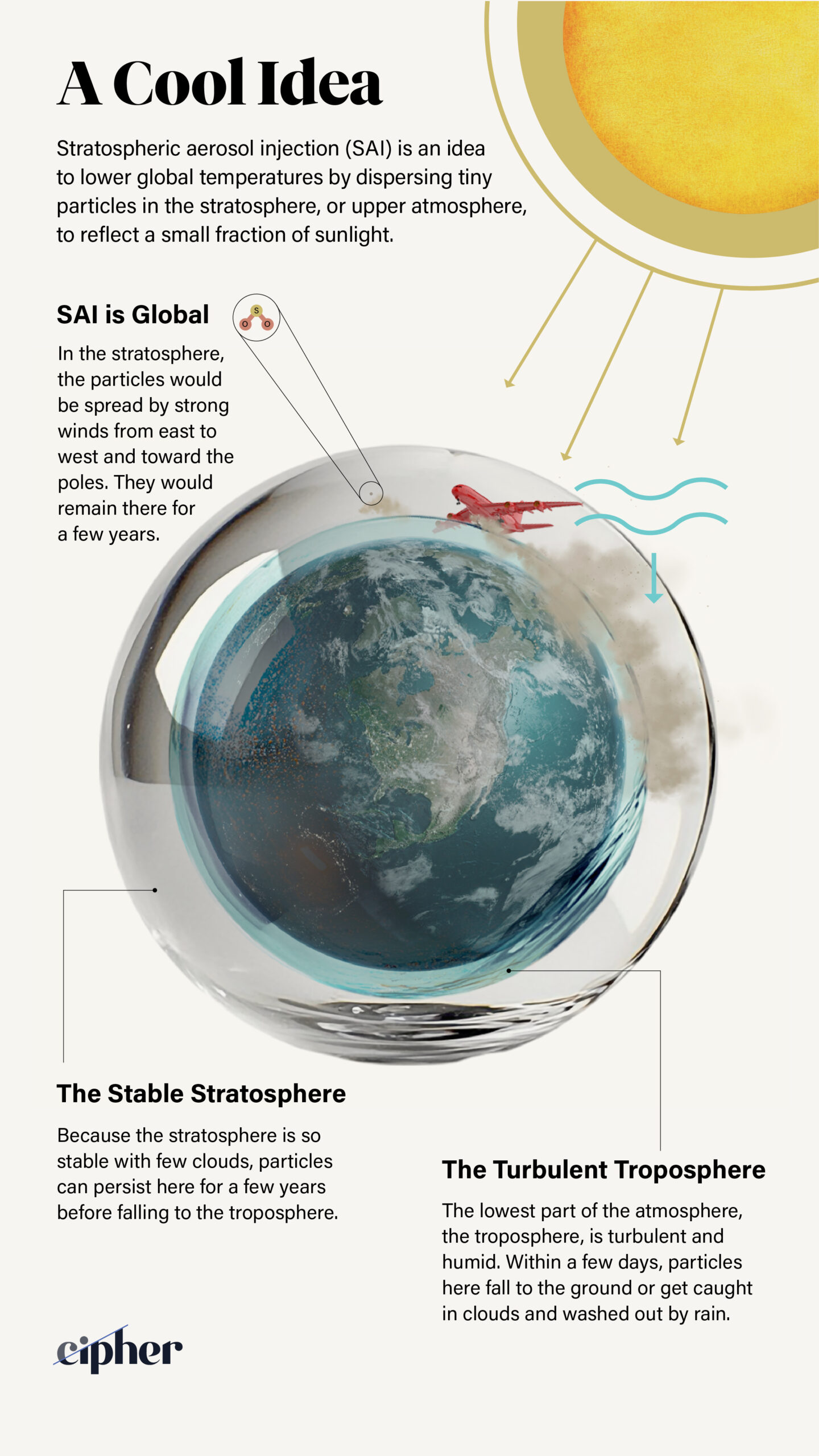
Infographic based on an image by SRM360, a non-profit knowledge hub that explores the science and evidence behind sunlight reflection methods, or solar radiation modification (SRM). Infographic by Nadya Nickels.
Modeling the risks
The type of solar geoengineering in the PNAS study, called stratospheric aerosol injection (SAI), mimics what happens when large volcanoes erupt: they throw sulfur in the air that can noticeably cool the planet for weeks, months or even years.
Volcanos provide “natural evidence” that SAI would work, said Tony Harding of Georgia Institute of Technology, another primary author of the paper.
There is a confusing irony at play: air pollution caused by burning fossil fuels actually cools the Earth a bit by reflecting some of the sun’s rays away from its surface. (During the Covid-19 pandemic lockdown, the sudden reduction of air pollution actually caused slight warming.)
Importantly, cooling caused by sulfur dioxide pollution isn’t enough to counteract the overall warming trend caused by the greenhouse gases emitted by fossil fuels. The decision to deploy SAI is a temporary shortcut – a way to reduce heat, and the deaths that come from that heat, in an emergency situation.
While it would be an effective band aid, it is not a get out of jail free card to reducing greenhouse gas emissions, scientists caution. SAI would reduce global temperatures and also increase air pollution, causing respiratory issues, and damage the ozone layer, increasing the risk of skin cancers.
To compare the benefit of cooler temperatures with harm caused by more air pollution and ozone damage, the researchers fed two analyses into a computer model. One projected the mortality risk of global warming and another considered the mortality risk of added sulfate emissions.
If SAI is deployed, the number of lives saved by the cooling effect is 13 times greater than the number of lives lost due to air pollution, the paper finds. To be clear, it is the lesser of two evils. Neither of these is a good outcome but one is less bad than the other.
It had been previously established that SAI would mitigate the harm of extreme heat in tropical regions, but that had not been directly compared to the mortality risks of ozone depletion and air pollution, said Bala of the Indian Institute of Science. This paper is the first to add a risk-risk analysis to the scientific discourse around solar geoengineering.
The authors make it clear their findings come with uncertainty; they estimate a 61% probability that the benefits of using solar geoengineering are greater than the risks.
That uncertainty comes largely from the variable impact cooling would have on mortality in different parts of the world: in very hot parts of the world, the reduction in temperature would almost certainly decrease mortality. In colder parts of the world, however, lowering temperatures could, in theory, increase mortality.
Notably, the cooling benefits of SAI could be especially helpful to the most vulnerable, poorest populations on the planet because they tend to be located in the hottest parts of the world, said Keith.
If emissions keep rising — which is the path we’re currently on — the benefits of SAI become clearer. “As the amount of warming from climate change increases, this uncertainty diminishes as benefits to hotter regions of the world begin to dominate,” Harding said.
As with most studies, the paper leaves open many avenues of additional research.
One area of additional study would be to better understand how heat impacts mortality risks for different populations, said Anna Bershteyn, professor in population health at NYU Grossman School of Medicine, who wasn’t part of the study: “We need maps of air conditioning penetration, electrical grid capacity and unavoidable outdoor activities.”