Five ways America risks global leadership on cleantech and climate
Latest News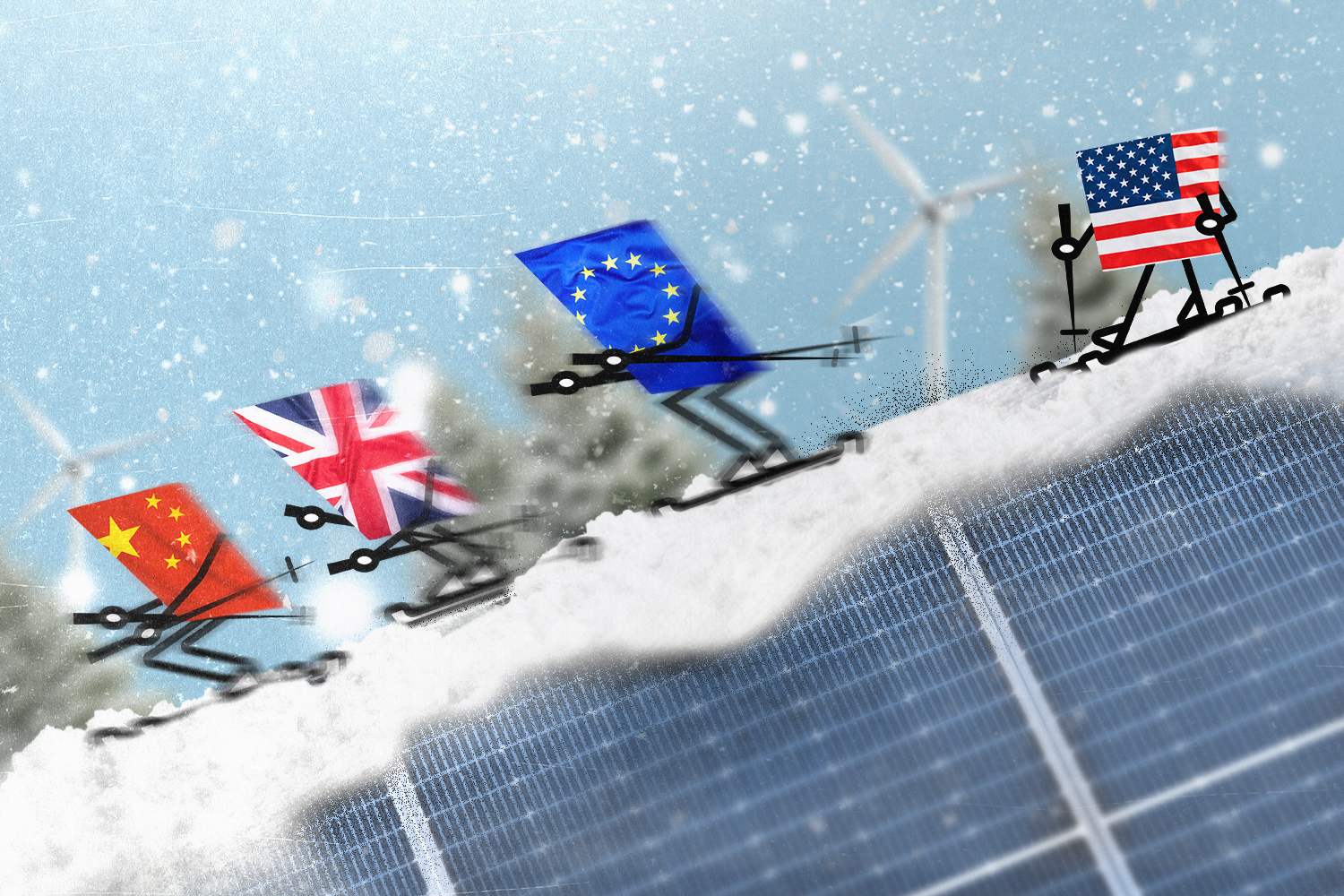
The Trump administration’s war on clean energy, from solar panels to electric cars and batteries, could imperil the United States’ leadership globally as those technologies gain favor around the world.
Cipher’s team looked at five ways this is showing up: Tariffs and prices, federal investments, new manufacturing, scientific research and climate negotiations.
In response to a request for comment, a spokesperson for the White House said President Donald Trump is committed “to protect[ing] America’s abundant natural resources while restoring our economic dominance.”
1. Tariffs could push prices higher
Trump’s escalating global tariff war threatens the competitiveness of American clean technologies, analysts say.
Within weeks of taking office, Trump imposed a 20% tariff on all Chinese goods, triggering export controls on lithium, a key element in energy storage and electric vehicle batteries. He then imposed and later delayed 25% tariffs on neighboring Canada and Mexico, while hitting global aluminum and steel imports with the same levy.
On Wednesday (April 2), which he has dubbed “Liberation Day,” Trump plans to announce a new round of retaliatory duties for an unspecified list of countries. Last week, he announced a 25% tariff on imported cars starting on April 3.
Boston Consulting Group estimates Trump’s steel and aluminum tariffs alone will add $22.4 billion to the cost of those imports and have “a far-reaching impact on manufacturing costs and supply chains across a range of industries in the U.S. and exporting nations.”
Tariffs are designed to raise revenue, fix trade imbalances and increase domestic production by making imported goods more expensive. Trump has said countries and companies won’t have to pay new tariffs if they invest in the U.S.
Last week, the Trump administration touted an announcement from car manufacturer Hyundai to invest $21 billion in the U.S. as proof the tariffs are already working. The company plans to expand its manufacturing efforts, including electric vehicles and batteries, and build a low-carbon steel plant in Louisiana.
“The president’s hardball tactics may very well pay off in the end, but in the short term, they are likely to cause potential heartburn for U.S. businesses,” and in the longer-term, lead to foreign retaliation and higher prices, said Rice University political science professor Mark Jones. — Amena H. Saiyid
2. Federal investments could be jeopardized
The U.S. risks losing momentum in manufacturing and building clean technology if the Republican-controlled Congress, with Trump’s backing, repeals key clean energy provisions of the 2022 Inflation Reduction Act.
Touted as the largest climate spending bill in U.S. history, the IRA includes tax credits, grants and loans for clean energy projects, including solar, wind and electric vehicles.
Now, tax credits and funding for these technologies are imperiled as Trump seeks to cut federal spending to pay for extending expiring tax cuts.
“The United States has already lost in the electric vehicle (EV) space,” Peter Gardett, head of research with Karbone, told Cipher, alluding to recent reports that Chinese low-cost electric vehicle maker BYD is generating $100 billion in revenue, surpassing sales of U.S.-based Tesla, which sells more expensive cars.”
After China, the U.S. was the second largest destination for global energy-transition spending last year, owing mainly to soaring investments in solar, batteries and electric vehicles, according to a recent BloombergNEF report.
At least $554.6 billion worth of clean-technology spending was announced last year, according to a Cipher analysis of Clean Investment Monitor data. The monitor is a joint database by Rhodium Group and the Massachusetts Institute of Technology’s Center for Energy and Environmental Policy Research to track investments in this space.
Some of those gains would likely be lost if Republicans in Congress and Trump roll back federal support.
“At least some of that investment would absolutely be at risk if the tax credits were to disappear,” Ben King, associate director with Rhodium Group’s energy and climate practice, told Cipher.
Not every Republican is on board with repealing the IRA. Earlier this month, 21 Congressional representatives wrote a letter to House Speaker Michael Johnson asking to preserve clean energy tax credits that have helped create factories and jobs in their districts. — Amena H. Saiyid
3. New manufacturing projects could be canceled
In addition to direct federal investments, the IRA — in combination with a separate effort to boost U.S. production of semiconductors — has sparked a surge in manufacturing around the country, especially in GOP-controlled states such as Georgia, Ohio and Texas. Hence the concern of some Republican lawmakers.
Other parts of the IRA subsidize purchases of U.S.-made electric vehicles. These subsidies — up to $7,500 per electric car and more for business purchases — are considered especially likely to go, political analysts say.
But economists say that the IRA’s producer and consumer subsidies work together to encourage U.S. production. If sales of electric vehicles and batteries slow down without purchaser subsidies, then factories under construction or planned could be scrapped, according to an analysis by Princeton University’s REPEAT Project.
The analysis concluded demand for EVs could be 30% smaller in 2027 if all of the IRA provisions were repealed, compared to keeping them in place, and 40% smaller by 2030. That would mean 8.4 million fewer electric cars made and sold by 2030, the study concluded.
Already, China dominates the markets for electric vehicles, batteries and almost every other aspect of the clean energy sector.
Meanwhile, Trump is trying to spur domestic mining of critical minerals, which are key to clean energy technologies, though his arguments for this center mostly on countering China. To what degree this will lead to new domestic facilities is an open question. — Bill Spindle
4. Research leadership could wane
The U.S. government historically has played an important role in global climate and energy research.
“The United States has the premier climate science research capability in the world, largely due to government support. Without that support, the United States’ leading role will erode,” said Alice C. Hill of the Council on Foreign Relations.
The Trump administration has cut staff at the National Oceanic and Atmospheric Administration, the federal science agency charged with weather and climate research in an effort to cut spending. Some NOAA employees were reinstated after a judge issued a temporary restraining order, but the potential for future layoffs lingers.
“The cuts to NOAA’s budget and personnel will damage the U.S. and NOAA’s climate science leadership, respected worldwide,” said Craig McLean, who worked at NOAA in leadership positions for 40 years. McLean said he has heard “grave concerns” from leaders in Europe, Asia and from U.S. industries.
“Everyone’s insurance rates, interest rates, food costs, cost of goods and more will increase because this version of America chooses to deny climate change. We elect policy [leaders] every four years. We do not elect science; it stands on its own merit,” McLean said.
Additionally, budget cuts to federal research programs, including at the National Institutes of Health and National Science Foundation, as well as canceled or withheld grants to research universities, have roiled scientific communities across the country.
Even though the final impact is not yet clear, said Andrew Dessler, a professor at Texas A&M University and the director of the Texas Center for Extreme Weather, “I can only imagine the cartwheels of joy that the Chinese are doing as the U.S. fritters away one of its greatest competitive advantages.” — Cat Clifford
5. Global climate action could suffer
Trump’s pulling the U.S. out of the landmark 2015 Paris Climate Agreement for the second time creates several unknowns that put further international climate collaboration at risk.
The withdrawal of the U.S., set to take effect by January 2026, comes at a critical time in the energy transition, when the effects of climate change are becoming increasingly palpable across the globe.
At home, the U.S. Environmental Protection Agency is formally reviewing what’s known as the “endangerment finding.” That’s a scientific finding underpinning the federal government’s legal ability to regulate greenhouse gas emissions. The move could have ripple effects with what the U.S. puts forward in negotiations.
China’s top climate envoy said last week, Bloomberg reported, that the U.S. exit from the Paris agreement has created the “most challenging moment” for negotiations since they started in 1990, but the world’s transition to clean energy will continue.
The main concern internationally with the U.S. pullout is whether other countries will follow suit. That hasn’t happened yet, but some countries, such as Indonesia, have questioned the value of domestic climate action if the U.S., the largest historic emitter of greenhouse gases, were out. The timing is delicate, as beefed up climate action will be discussed at the next United Nations climate summit in Brazil in November, even as many governments missed a February deadline to submit their plans.
Another big concern is how the U.S. government will behave on the world stage going forward. When the U.S. first withdrew from the Paris climate deal in 2017, the American delegation still engaged in international climate gatherings at a low level, said an official who has long participated in climate negotiations and asked to remain anonymous to speak candidly.
However, now “there are a lot of wild cards, with the U.S. potentially coming in strong to create a coalition of the unwilling,” he added.
After the U.S. helped prevent the disbursement of World Bank-linked climate financing to South Africa earlier this month, the fear is it could do so again, impacting global investments in clean energy.
“We have some real danger signs and warning clouds” but it’s not yet clear how aggressive the U.S. strategy will be, the official said. — Anca Gurzu