Fake news causes headaches for Europe’s wind industry
Latest News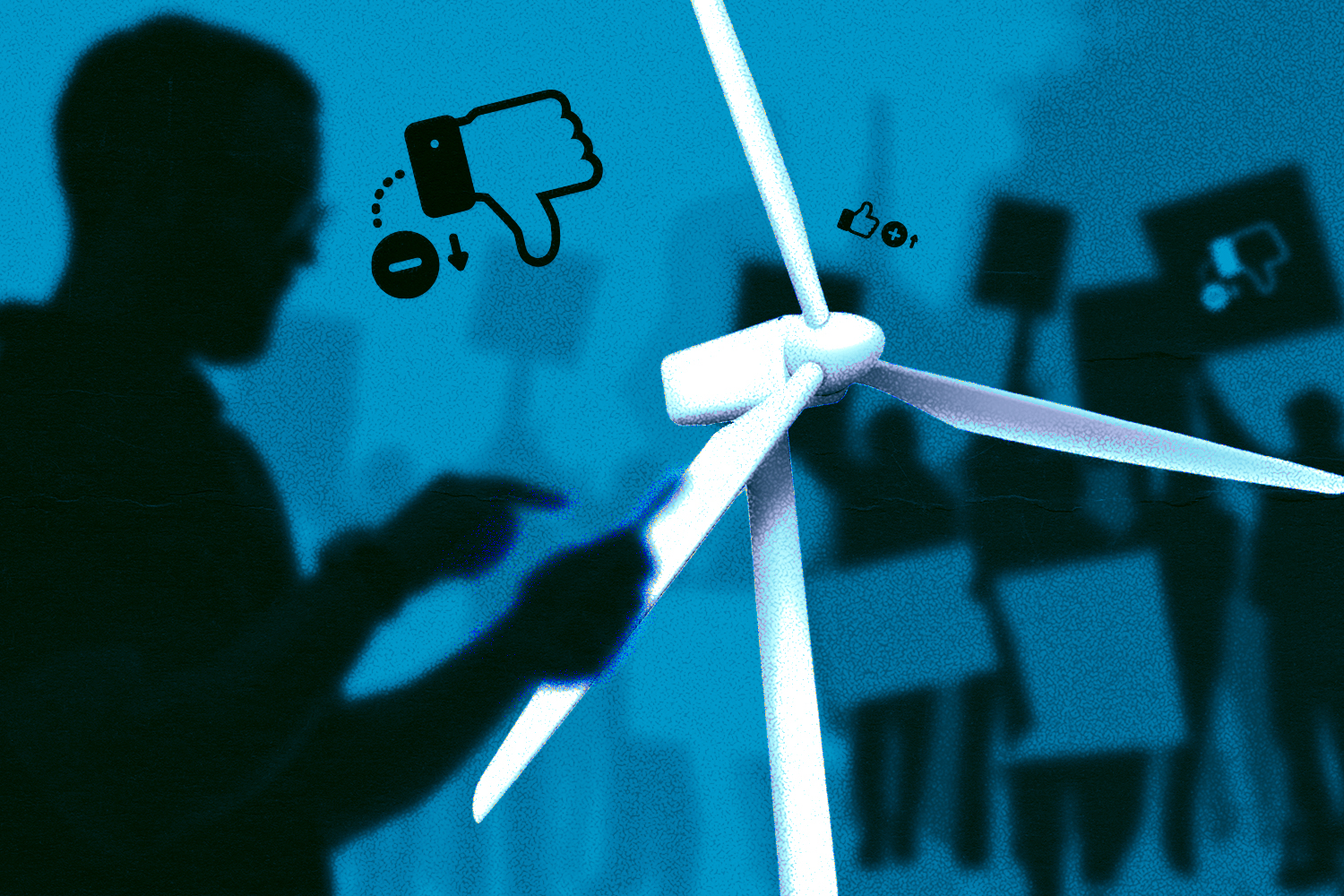
COPENHAGEN, Denmark — Three contestants stood on stage ready for a round of true-or-false questions about wind energy.
Wind turbines cannot be combined with farming — True or false? False.
Most blades end up in landfills after being decommissioned — True.
Wind turbines attract lightning during storms — True.
Wind turbines cause electromagnetic radiation that can make people ill — False.
The contestants weren’t just regular participants. They were wind industry experts from companies and lobby groups — and, surprisingly, even they got some of the answers wrong.
The quiz marked the beginning of a panel debate about wind misinformation at the yearly gathering of European wind energy professionals in Denmark in April.
False narratives around the impact of wind energy on everything from land to health to marine life have morphed in recent years from small-scale opposition aimed at individual projects to globally coordinated campaigns targeting the technology as a whole.
The wind industry says these campaigns are already causing more project appeals and delays; they worry things will only get worse.
“This poses huge real-life problems for Europe’s wind industry,” said Christoph Zipf, communications manager at Wind Europe, the lobby group that organized the gathering in Copenhagen. “Where these disinformation campaigns are successful, they will almost certainly delay the deployment of wind energy.”
To make matters worse, it is hard to know exactly who is behind these efforts, although they have been linked to far-right groups and foreign actors. It is also challenging to directly measure the impact of these campaigns, which largely spread online.
“It already costs the industry millions of Euros in additional communication needs and litigation costs,” Zipf said.
Across the Atlantic, the wind industry is engaged in the same struggle. United States President Donald Trump has repeated false claims about wind turbines hurting whales and causing cancer that have been debunked by major news outlets and the National Oceanic and Atmospheric Administration. The Trump administration temporarily halted federal permitting for all U.S. wind projects at the beginning of the year and paused all leasing of federal waters for offshore wind.
Real-world impacts
A little vocabulary lesson: Misinformation is false information presented as fact unintentionally, like someone sharing a Facebook post not knowing the information in it is wrong; disinformation refers to false information spread deliberately, often by groups or individuals with an agenda.
While it is difficult to attribute the fate of a particular project directly to mis- or disinformation, wind projects around Europe (and elsewhere) seem to be facing more and more opposition.
In the Spanish region of Galicia, a storm of legal cases is blocking wind projects. In a non-binding referendum in the Austrian region of Carinthia earlier this year, more than half of the participants voted in favor of banning new wind turbines in the region. In Italy’s Sardinia, the regional government implemented an 18-month ban on new renewables installations amid growing public skepticism. In Germany, the far-right Alternative for Germany (Afd) party has previously campaigned on dismantling all wind power plants.
Communities often have legitimate questions and concerns about new energy infrastructure, and it’s well documented that people don’t want the projects in their backyards. False narratives can legitimize and amplify such concerns.
“Misinformation tends to increase doubts, especially on a local and regional level,” Florian Maringer, managing director at Austrian Wind Energy Association, told Cipher in a statement. “Local interest groups — as a very loud minority — get a lot of attention and coverage.”
The bigger challenge comes from social media and more targeted campaigns.
“For some years now, we’ve been facing a wave of professionalized and coordinated disinformation campaigns,” said Zipf. “They often take place online and come in the form of anti-wind blogs, influencers, fake accounts, bot networks or AI-generated content.
The recent rise in mis- and disinformation is largely in sync with wind energy’s visible rise across Europe, with hundreds of turbines now dotting fields and seas.
“Who is truly behind these campaigns is difficult to figure out, but my sense is that there are a series of interlocking actors,” said Carl Miller, co-founder of CASM Technology, a company that uses artificial intelligence to detect and analyze how information is manipulated online to influence behaviors and attitudes.
Miller points to autocratic governments such as Russia. The country’s digital warfare infrastructure has been well documented and NATO last year detailed how Russia is seeking to spread climate disinformation. It could be that Kremlin-linked actors are keen to “promote narratives of wind energy being unreliable” as they try to undermine the transition away from the fossil fuels that underpin Russia’s economy and mobilize far-right movements across Europe, said Miller.
Far-right groups have also “taken up green energy as a totemic issue” that they regard as left-wing and elite-driven, Miller said.
Miller added a third potential operative, one with capitalistic motivations. “We shouldn’t write off the possibility that commercial actors are conducting disinformation campaigns against the wind sector,” he said.
A challenging response
Industry developers and officials worry false information can easily outpace efforts to set the record straight.
“In the past, we have supported project developers in explaining the benefits of wind energy. We have helped debunk myths and address project-specific concerns,” said Zipf. “But faced with coordinated, digital misinformation campaigns, it quickly becomes impossible to rectify each post and debunk each misperception.”
Limits on the data fact checkers can scrape from websites like TikTok also make it challenging to get a full view of the problem, said Stephan Mündges, coordinator at the European Fact-Checking Standards Network (EFCSN), which brings together European organizations working to combat misinformation across a variety of topics. “This is a game of scale. If you don’t have data access, you have nothing to match existing claims to.”
Fact-checking and archiving available data also takes a lot of storage and computing power and, “quite frankly, more money than we as a community currently have,” he added.
Wind Europe, meanwhile, is trying to enhance its monitoring capacity to respond more quickly to misinformation campaigns, highlight positive aspects of wind energy and spread its own, accurate information. To that end, the European Commission recently published key facts around wind energy.
“The way to fight or mitigate this is to spread the good news about renewables,” said Rafael Solís Hernández, who deals with public affairs at Portuguese energy major EDP.
Unfortunately, sharing the good news can only do so much. Miller of CASM Technology suggests adapting the tactics used in many types of disinformation campaigns to rebut them.
“You have to introduce chaos, risk and failure” into the disinformation campaigns themselves, said Miller, referencing tactics he outlined in a blog post last year. “You have to reverse engineer the operation.”