Eleventh-hour hydrogen rule to face uncertainty in Trump administration
Latest NewsBiden administration softens rules for claiming tax credits to make hydrogen
The Biden administration finalized long-awaited federal guidelines for the clean hydrogen industry just over two weeks before President-elect Donald Trump enters office, injecting uncertainty into the nascent sector.
The Treasury Department guidelines, first proposed a year ago, govern tax credits subsidizing clean hydrogen, which is currently far more expensive than hydrogen made from fossil fuels.
Companies that had been sitting on projects until this guidance was finalized may move forward claiming production tax credits worth millions of dollars, but such momentum could be short-lived. It is unknown whether this guidance will persist in its current form or be revised under the new Trump administration. A request for comment to the transition team was not immediately returned.
These first-of-their-kind tax credits, created as part of the 2022 Inflation Reduction Act, are seeking to kickstart what is essentially a non-existent sector to help reduce carbon emissions in everything from steelmaking to transportation. Most hydrogen made today, used in industrial applications like fertilizer and chemicals, is from unabated fossil fuels.
“These rules incorporate helpful feedback from companies planning investments which will drive significant deployment of clean hydrogen to power heavy industry and help create good-paying jobs,” U.S. deputy secretary of the Treasury Wally Adeyemo said in a press release accompanying the rules. His comments did not address the elephant in the room: the potential for the Trump administration to rewrite the guidelines.
The final guidelines largely maintain the strict limits initially proposed in late 2023, with a softening of the rules in a few key places (more on that below). In any case, they may be coming too late to drive any such investments.
The rules will go into effect next week, but they could still be challenged or overturned through the legislative process with Republicans in control of the U.S. Congress.
Only existing hydrogen producers will potentially be able to take advantage of the credit in the short period before the new administration takes over, said Payal Kaur, Americas hydrogen analyst at BloombergNEF.
“Because the Trump administration’s view on the hydrogen tax credit is still unknown and BNEF’s position is President-elect Trump will likely relax [the] rule further rather than slash it, it wouldn’t make sense for developers to take a final investment decision based on this guidance if the changes are unknown,” Kaur added.
BloombergNEF expects producers to focus on making hydrogen from natural gas equipped with carbon capture and storage (CCS). These projects already make up nearly 80% of the forecasted U.S. supply and many are in the advanced planning stages, supported by generous carbon capture and storage tax credits, which enjoy bipartisan support and are less unlikely to be changed by the incoming administration.
Here’s a rundown of what’s changed — and what’s not — in the final rule:
- Those making hydrogen with electricity from the nearby power grid will still have to certify the power is from renewable sources added or expanded in the last three years, as proposed.
- But the producers will have until 2030 — instead of 2028 as originally proposed — to show they are making this versatile molecule using electricity from the grid in the same region at a time when renewables are generating power, a concept known as hourly matching. Until then, they will have more relaxed criteria for matching generation to production.
- In a change from the proposal, producers will be able to use battery storage to meet hourly requirements.
- In another change, producers won’t have to certify their clean power sources were added in the last three years in states with legally binding clean electricity standards and decarbonization targets, but they will have to meet hourly matching and regional delivery requirements. Treasury determined California and Washington meet that bar, but others could qualify as well.
- For hydrogen producers using natural gas with carbon capture and storage, the value of the tax credit they receive will be calculated in a government-approved computer model based on a national average of carbon emissions from upstream natural gas production. In a change from the proposed guidance, Treasury said it would use actual upstream emissions measurements in future updates to the government model.
- A range of interests — heavy industry, hydrogen producers, renewable energy developers, business trades and even some environmental groups — objected to the use of an industry-wide emissions average, saying relying on averages undercuts producers who have achieved lower emissions in natural gas production.
- The guidance also clarifies that hydrogen producers can use up to 200 megawatts of electricity from existing nuclear reactors if the power plants meet certain criteria.
- Hydropower will need to meet the same criteria as wind, solar and other renewable projects.
- And the guidelines expand the definition of clean hydrogen to include hydrogen made with natural gas released from landfills, animal manure, wastewater and agricultural waste.
Indeed, clean hydrogen can be made through various processes, but the two dominating the tax credit debate have been its production via electrolysis (splitting water using renewable energy to release the hydrogen) and natural gas equipped with CCS.
The former approach drew controversy as studies by Princeton University and others showed hydrogen made with electricity from the nation’s power grid, which comes mostly from fossil fuels, would double greenhouse gas emissions compared with hydrogen made directly using electricity generated by zero-emitting sources, such as wind, solar, geothermal, nuclear and hydropower.
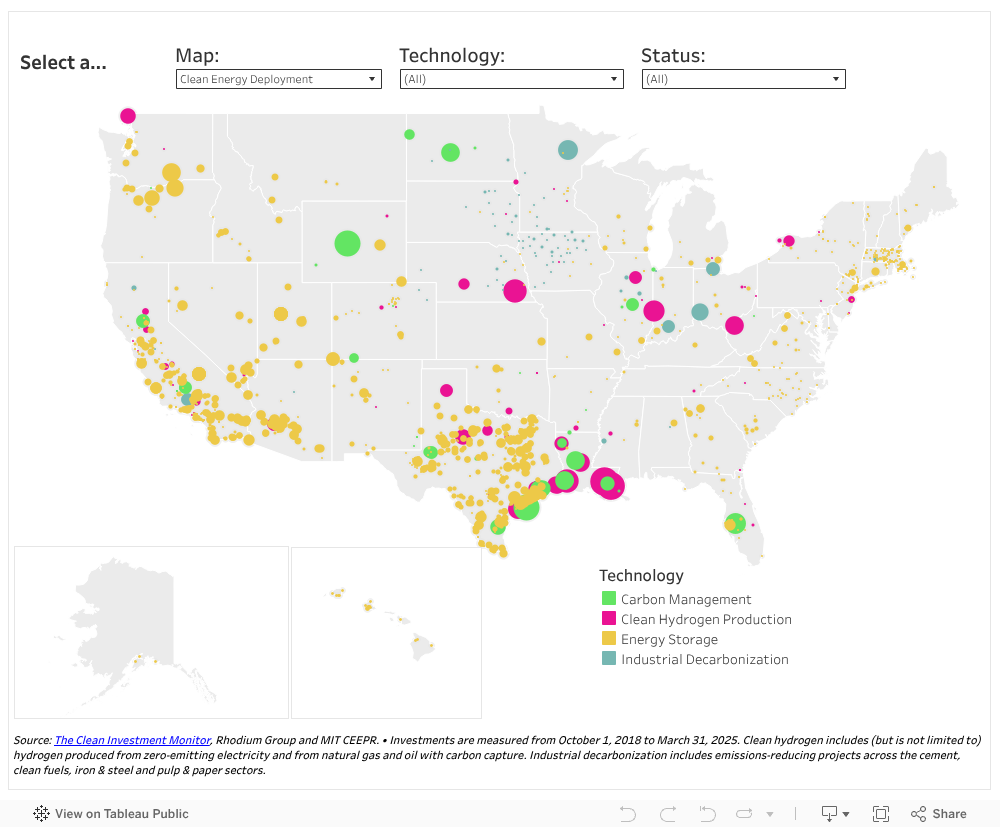
Cipher’s Cleantech Tracker, below, tracks a range of projects eligible for IRA money, including clean hydrogen.
The final regulations do reflect an effort to address concerns by hydrogen producers, Mona Dajani, global co-chair of energy, infrastructure and hydrogen at the law firm Baker Botts.
“This final rule significantly expands flexibility to kickstart the clean hydrogen industry but keeps a strong foundation,” said John Coequyt, director of U.S. government affairs at the non-partisan clean energy group RMI in a statement. “The rule is comprehensive and detailed enough to manage the myriad ways hydrogen could be produced.”
As they waited for the final guidance, producers like Plug Power placed many projects on hold. At the start of 2024, there were 14 million metric tons of announced annual clean production capacity waiting in the wings, according to the U.S. Energy Department’s recently released program plan.
As the year progressed, investors and producers were hesitant to announce more new projects. Others ended up pulling back; industrial gas firm Air Products & Chemicals withdrew from the largest renewable-powered hydrogen project in northern Texas in December.
A Cipher analysis found announced investments in clean hydrogen dropped from a high of $18 billion in 2022 to just $1.27 billion through the first three quarters of 2024. (Fourth quarter numbers, which will include the election outcome impacts, are due out in February).