CERAWeek and the power of plenty
Reporter's Notebook
HOUSTON — More, more, more … That’s been the mantra of CERAWeek by S&P Global this year, the giant energy conference held annually in Houston.
For more than a decade now, everyone from President Barack Obama to the heads of major oil companies have espoused a more-of-everything approach to energy policy, almost ritually calling for the whole array of sources, from oil and gas to renewables.
This year, the reigning executives of the energy industry seemed to really mean it, even if they talked more about fossil fuels than renewables.
Through hundreds of panel discussions and thousands of meetings, the force behind the new seriousness was the prospect of fast-growing energy demand over the next decade, at least, especially for electricity to serve an explosion of data centers, power new electric cars and allow a resurgence of manufacturing.
“Terrifying demand growth,” Jason Grumet, CEO of the American Clean Power Association, said of the hunger for electricity he’s expecting.
“Almost like a frenzy,” said Michele Wheeler, vice president at NextEra Energy Resources, describing the requests the company is fielding for new power as fast as can be delivered.
Even utility executives, renowned for their deliberate caution, were talking up the need for “speed” and “creativity” to meet the moment.
Conference attendance was near record highs, with more than 8,000 participants from some 80 countries listening to 1,400 speakers on hundreds of panels and faux casual “fireside chats” over the course of the week.
CERAWeek, held in the business capital of the oil and gas patch, has always been a largely fossil-fuel sector gathering and this year was no different, with oil and gas executives expressing maximum optimism while being cheered on by senior Trump administration officials.
One panelist pronounced a new “golden age of gas,” followed by the admission he “never thought I would say that in my lifetime.”
A few panelists sheepishly expressed concern that some of the wide-eyed forecasts about energy demand might not come to pass — a situation the industry has faced many times before. But just as often they were met with confidence that any oversupply — such as from the expected 60% expansion in U.S. liquified natural gas export capacity before 2030 — would simply push prices lower, triggering a new surge in demand.
Not all sources of energy drew universal cheers. Trump administration Energy Secretary Chris Wright dissed wind and solar as insufficient to replace fossil fuels in his opening address to the conference. He trumpeted not only oil, gas and even coal, but also nuclear, geothermal and fusion energy.
Interior Secretary Doug Burgum, who encouraged both wind and oil production in his previous post as governor of North Dakota, spent several days at the conference, meeting with executives and announcing from the main stage that the administration would “unleash” oil and gas from Alaska and every other state where those resources are found.
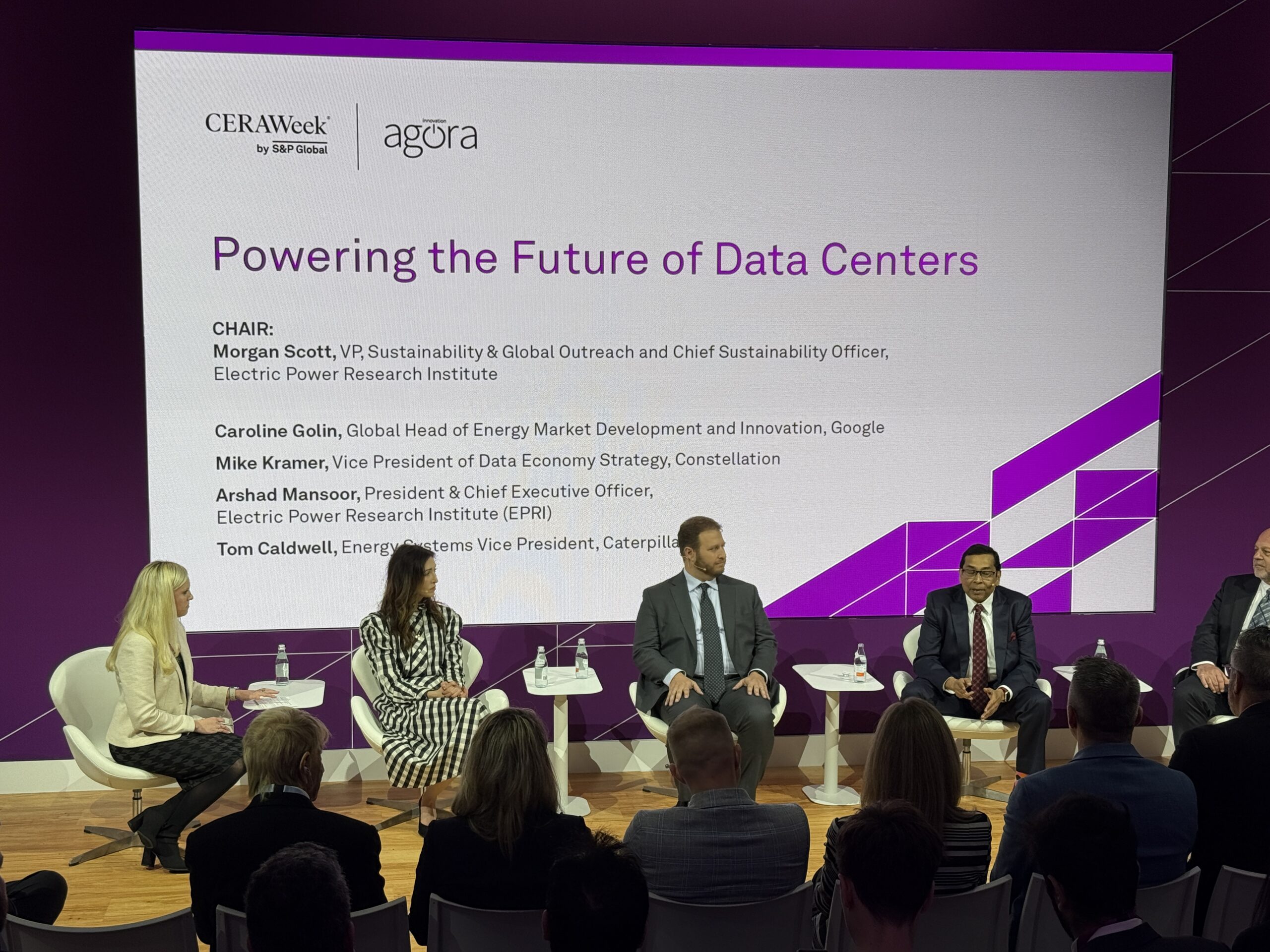
A panel at CERAWeek by S&P Global in Houston in March 2025 on “Powering the Future of Data Centers.” Panelists (L to R): Morgan Scott, VP sustainability and global outreach and chief sustainability officer at Electric Power Research Institute; Caroline Golin, global head of energy market development and innovation at Google; Mike Kramer, vice president of data economy strategy at Constellation; Arshad Mansoor, president and CEO of Electric Power Research Institute; Tom Caldwell, energy systems vice president at Caterpillar, Inc.
More than a dozen panels about every conceivable aspect of the natural gas market — from U.S. exports of LNG to custom-designed generation for individual data center clusters drew standing-room only crowds.
“It’s an interesting challenge in the market right now,” Bill Newsom, president of Mitsubishi Power Americas, told me describing the back up of orders his company has for the natural gas generators it makes.
“I’ve been in the industry for 30 years and I’ve never seen the industry with so much demand,” he said. “We’re building flat out.”
Executives from renewable energy companies — solar panel manufacturers, battery makers and a small wind energy contingent — generally spoke to smaller audiences. But they were no less enthusiastic about their prospects and appeared undeterred by the occasional disparaging evaluation of their technologies, especially from Secretary Wright.
Overall, the vibe was inclusive: the pie is expanding and there’s going to be more need for more players to provide more energy.
“We have to build more,” said Arshad Mansoor, president and chief executive of the Electric Power Research Initiative, an energy industry think tank. “New transmission. New generation. All kinds of generation.”