After years of historic growth, industrial cleantech investments falter
Data DiveInvestments into low-carbon technologies in the industrial sector have grown enormously over the last four years, thanks largely to federal subsidies in the Inflation Reduction Act and related new laws — but they’re starting to fall as Washington rolls back those same policies.
Such investments include a sundry mix of nascent technologies, like clean hydrogen, sustainable aviation fuel and carbon management, aimed at cleaning up a range of industrial processes.
These investments fell in early 2025 after climbing for more than three years — a sign of the uncertainty roiling the cleantech market in the United States, according to a recent analysis by Rhodium Group and the Massachusetts Institute of Technology Center for Energy and Environmental Policy Research.
Investments into industrial decarbonization technologies (shown in the chart above) edged down 3% in the first quarter of 2025 to just under $1.5 billion. Those investments are expected to fall further as companies pledge less money to the sector.
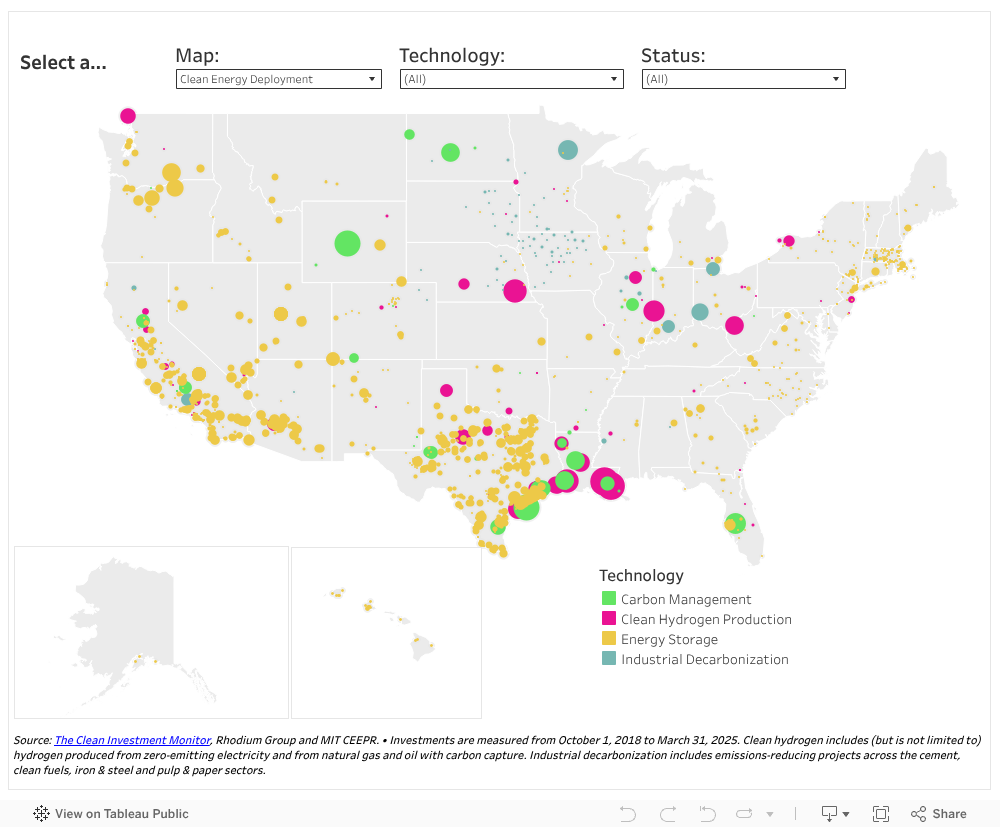
These types of industrial cleantech investments, which also include technologies that cut emissions from cement, iron and steel, are earlier in their development stage compared to, say, wind and solar, so federal support is far more important.
Bigger picture, investments in all manner of clean-energy technologies have grown significantly in the past few years, driven by laws passed during the Biden administration, including the 2022 Inflation Reduction Act and the 2021 Bipartisan Infrastructure Law.
Cleantech investments made up 4.7% of all private investments in structures, equipment and durable consumer goods in the U.S. in the first quarter of 2025. While that’s down slightly from 4.9% in the last quarter of 2024, it still represents significant growth since 2018, when it was just 1.2%, according to Rhodium data.
The IRA has been “a big driver of our economic growth in the U.S.,” said Hannah Hess, associate director with Rhodium Group’s energy and climate practice.
But examining other data suggests a potentially much-different future, especially for nascent industrial decarbonization technologies.
Although not shown in the above chart, the value of announced investments into such projects in the first quarter of this year fell off a cliff compared to a year ago: Just $79 million — from $16 billion.
“It’s a really staggering decline,” said Hess, connecting it to the federal policy changes ushered in by President Donald Trump’s second administration.
“In general, we would attribute the drop-off in announcements to uncertainty around the tax credits … and also around the public funding in the form of grants, loans and loan guarantees,” Hess said.
Congress is looking to significantly roll back tax credits originally passed in the IRA. And the Trump administration has attempted to claw back related funding already awarded under Biden’s administration for clean energy and climate projects.
To wit, on Friday, Energy Secretary Chris Wright announced the U.S. Energy Department was canceling awards to 24 projects worth $3.7 billion. Many of those projects were in the industrial decarbonization sector, including carbon capture and sequestration projects and decarbonized cement projects.
ExxonMobil’s nearly $332 million award for a project in Baytown, Texas, where the oil giant was testing technology to produce chemicals burning hydrogen instead of fossil fuels, was canceled. And two decarbonized-cement startups, Brimstone and Sublime Systems, also had their awards rescinded, for $189 million and almost $87 million, respectively.
Editor’s note: Brimstone’s investors include Breakthrough Energy Ventures, part of Breakthrough Energy, which also supports Cipher.